Gold Repricing 2026: How Government Gold Revaluation Works and What It Could Mean for Investors
Free Gold IRA Guide
Find the company path that fits your investment range
Answer two quick questions to see the Gold IRA company path matched to the amount you’re considering. No name, email, or phone number is required to view the result.
Find My Gold IRA Match →Precious Metals Central may receive compensation if you open an account through a link shown after the guide. This does not increase your cost. Review provider terms independently.
What Is Gold Repricing? A Plain English Explanation
Gold repricing refers to a government’s official adjustment of the value assigned to its gold reserves. In simple terms, it’s when a nation decides to change the price at which it accounts for the gold it holds in its vaults. This isn’t about market forces naturally driving gold prices up or down, but rather a deliberate policy decision to revalue gold on national balance sheets.
When a country reprices its gold reserves, it essentially declares that the precious metal is now worth more (or theoretically less) than previously stated. This administrative action doesn’t directly change the market price of gold, but it can have significant implications for currency valuation, national debt ratios, and global financial markets.
Think of it as similar to a company revaluing a major asset on its books. If a business suddenly declares that a property it owns is worth twice as much as previously recorded, its balance sheet immediately looks stronger—even though nothing physical has changed.
Why the U.S. Still Values Gold at $42.22 Per Ounce
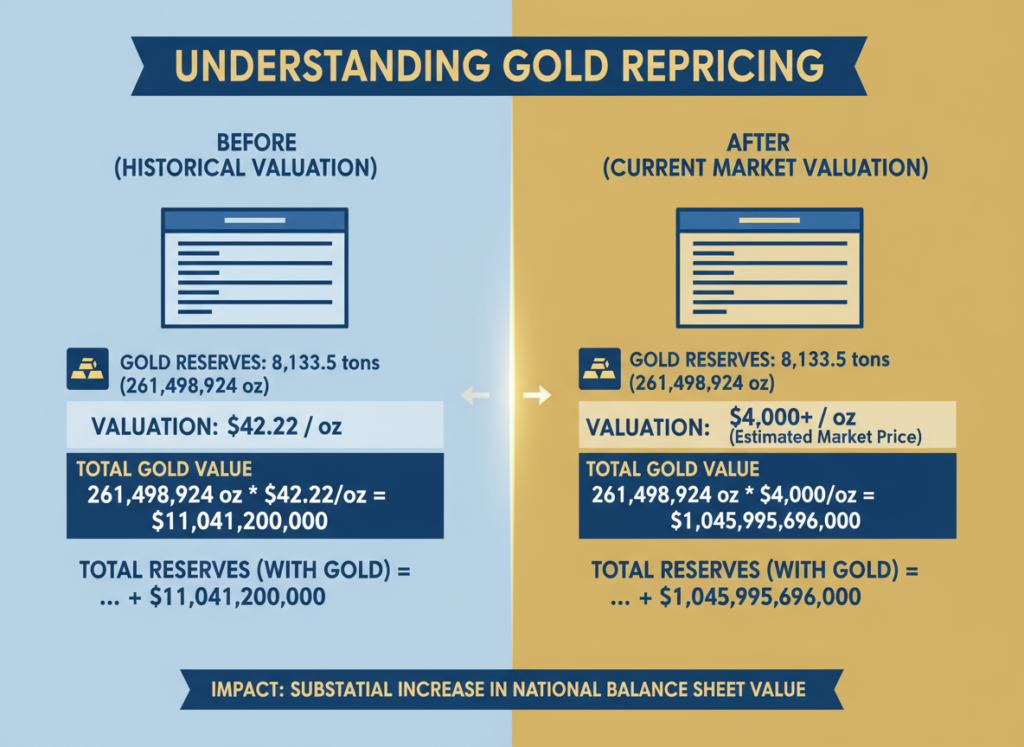
One of the most peculiar aspects of the current monetary system is that the United States government officially values its gold reserves at $42.22 per ounce—a figure that has remained unchanged since 1973 and stands far below current market prices.
This seemingly arbitrary valuation is a relic of the transition away from the gold standard. When President Nixon ended the dollar’s convertibility to gold in 1971, it set in motion a series of events that led to the official price being set at $42.22 in 1973. Despite massive inflation and market price increases since then, the U.S. Treasury has maintained this valuation on its books.
Accounting Consistency: Changing the valuation would require acknowledging the dollar’s depreciation against gold over decades.
Political Considerations: Revaluing gold would raise questions about the nature of money and the Federal Reserve’s monetary policy.
Balance Sheet Impact: A repricing would dramatically alter the government’s financial position overnight.
Gold’s Ambiguous Role: Maintaining the low valuation helps minimize gold’s official importance in the monetary system.
This artificial valuation creates a massive discrepancy between the Treasury’s stated value of America’s gold reserves (approximately $11 billion at $42.22/oz) and their actual market value (over $500 billion at current prices). This gap represents potential “hidden wealth” on the national balance sheet that could be officially recognized through a repricing event.
Updated October 2026 · Precious Metals Central rankings
Top 5 Precious Metals Companies for 2026
Large, readable comparisons for retirement-age investors. Rankings reflect account fit, service focus, storage options, existing fee information, and the editorial assessment described on this site.
#1
Best for larger accounts
Augusta Precious Metals
Education-first Gold IRA support for people considering $100,000 or more in eligible retirement savings.
PMC fit
$100,000+
Provider minimum
$50,000†
Sample recurring
$225†
PMC score
4.9 / 5
Known for high-touch education and support for larger retirement accounts. Confirm all current costs and eligibility before proceeding.
In practice, a gold repricing is usually part of a larger gold revaluation strategy. The repricing represents the specific act of changing the official price, while revaluation encompasses the broader policy framework and implications of that change.
For example, when President Roosevelt increased the official gold price from $20.67 to $35 per ounce in 1934, this was technically a repricing. However, it was part of a comprehensive gold revaluation that included confiscating private gold, devaluing the dollar, and restructuring the monetary system.
Historical Precedent: The 1933 FDR Gold Revaluation
The most significant gold revaluation in American history occurred during the Great Depression under President Franklin D. Roosevelt. This historical episode provides valuable insights into how a modern gold repricing might unfold.
In 1933, facing a banking crisis and economic collapse, Roosevelt took a series of dramatic steps:
Executive Order 6102 (April 5, 1933): Required Americans to surrender most privately held gold coins, bullion, and certificates to the Federal Reserve in exchange for $20.67 per ounce.
The 1933-34 gold revaluation demonstrates how governments can use gold repricing as a tool during economic crises. It shows that such actions often come with significant restrictions on private ownership and can be used to generate substantial resources for government spending. While the specific circumstances of the Great Depression differ from today’s economic environment, the mechanics of how a repricing works remain relevant.
How Gold Repricing Could Strengthen Government Balance Sheets
One of the primary motivations for a potential gold repricing in 2026 or beyond would be to strengthen government balance sheets that are increasingly strained by mounting debt levels. The mathematics of this process are straightforward but powerful.
Consider the United States, which officially holds about 261.5 million ounces of gold. At the current official valuation of $42.22 per ounce, these reserves are worth approximately $11 billion on the national balance sheet. However, at a market price of around $2,000 per ounce, the same gold would be valued at over $523 billion—a difference of more than $512 billion.
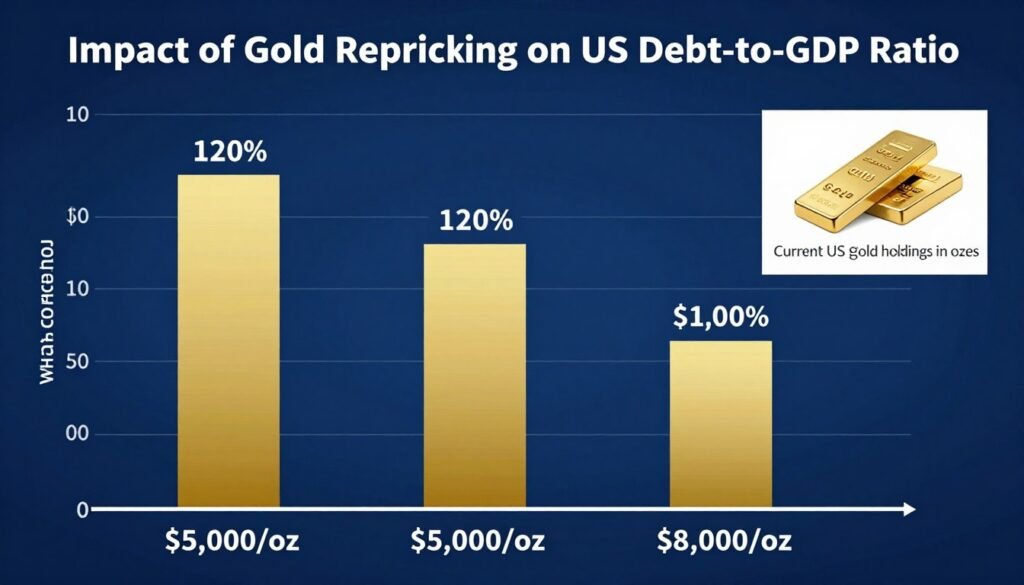
If the U.S. were to reprice its gold to $5,000 per ounce (a figure often discussed in repricing scenarios), the value would jump to $1.3 trillion, creating over $1.29 trillion in “new” assets on the books without acquiring a single additional ounce of gold.
This accounting adjustment could have several significant benefits for government finances:
Improved Debt-to-Asset Ratios: By increasing the value of assets without changing debt levels, governments could instantly improve their financial position.
Enhanced Borrowing Capacity: Better balance sheets could lead to improved credit ratings and lower borrowing costs.
Potential for Debt Reduction: The “profits” from repricing could theoretically be used to pay down existing debt.
Currency Stabilization: A stronger asset base could help support currency values during periods of instability.
It’s important to note that while this accounting change would be real, it wouldn’t create actual new wealth—it would simply recognize the market value of an existing asset that is currently undervalued on the books. However, the psychological and practical effects on financial markets could be substantial.
Free Birch Gold Precious Metals Kit
If you’re researching physical gold or silver, the free kit helps you understand the basics, risks, and options.
Why $7,500–$8,500 Gold Is Often Discussed by Analysts
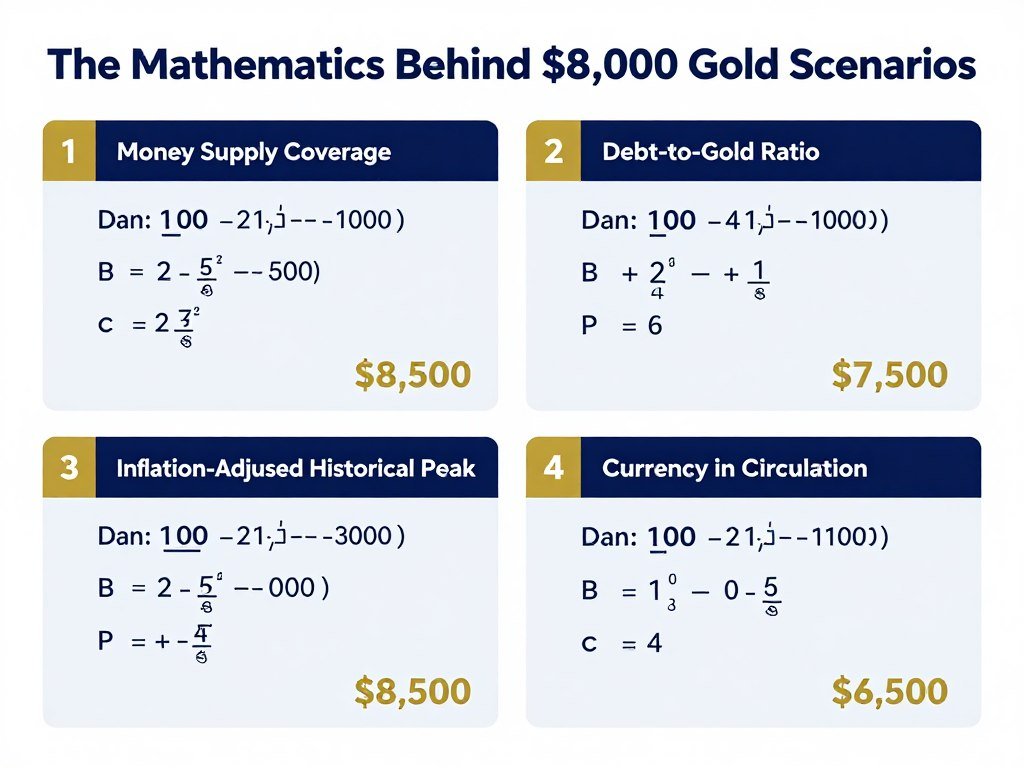
When discussing potential gold repricing scenarios for 2026, analysts frequently mention the $7,500–$8,500 range. These figures aren’t arbitrary but are based on specific economic calculations related to money supply, debt levels, and historical gold-backing percentages.
The Mathematics Behind Higher Gold Price Projections
Several methodologies lead analysts to these price targets:
Money Supply Coverage: If gold were to back even a portion of the money supply (M1 or M2), prices would need to be much higher than current levels. With M2 around $20.7 trillion and U.S. gold reserves at 261.5 million ounces, even a 40% backing would require gold at approximately $8,000 per ounce.
Debt-to-Gold Ratio: The U.S. national debt exceeds $33 trillion. If gold reserves were to cover 25% of this debt (a historically significant level), the price would need to be around $8,500 per ounce.
Inflation-Adjusted Historical Peaks: The 1980 gold price high of $850, adjusted for inflation using true inflation metrics rather than official CPI, would place gold between $7,000 and $9,000.
Currency in Circulation: Looking at just the physical currency in circulation globally compared to above-ground gold supplies yields similar price targets.
The $8,000 Gold Scenario
The specific $8,000 gold scenario is particularly notable because it represents a level at which gold would become a meaningful counterbalance to global debt. At this price:
U.S. gold reserves would be valued at approximately $2.1 trillion
This would represent roughly 10-15% of global government debt
Such a ratio is historically significant for maintaining confidence in monetary systems
While these projections may seem extreme compared to current prices, they reflect the mathematical reality of what would be required for gold to resume a meaningful role in the global monetary system given today’s debt levels and money supply figures.
Relationship Between Gold Repricing, Inflation, and Debt
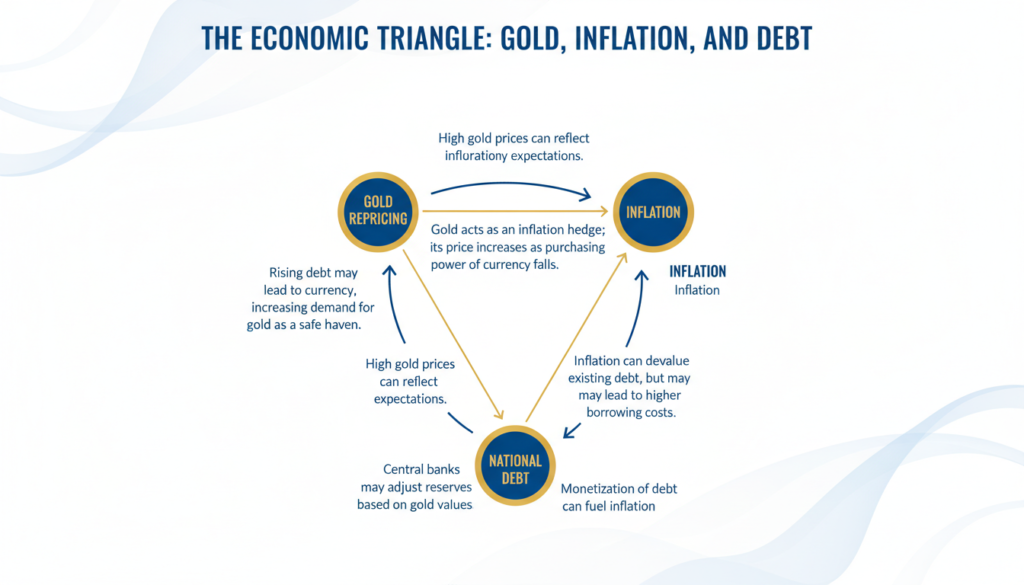
The interconnection between gold repricing, inflation, and sovereign debt forms a complex economic triangle that helps explain why governments might consider repricing gold in 2026 or beyond.
Inflation Hedge:Gold’s reputation as an inflation hedge means that periods of high inflation often coincide with rising gold prices, creating favorable conditions for repricing.
Debt Reset Mechanism: Gold repricing could function as part of a broader debt restructuring or reset strategy.
The historical pattern suggests that when both inflation and debt reach critical levels, monetary authorities often turn to gold as part of the solution. A repricing acknowledges the reality that gold’s value has increased as currencies have been debased through inflation and debt expansion.
In the current environment, with U.S. debt exceeding $33 trillion and recent inflation running well above the Federal Reserve’s 2% target, the conditions for considering a gold repricing are increasingly favorable from a government perspective.
What Gold Repricing Signals for Investors (Even If It Never Happens)
Whether or not a formal gold repricing occurs in 2026, the mere discussion of such a possibility carries important signals for investors. The factors that would drive governments to consider repricing gold are themselves significant indicators for investment strategy.
Even if a formal repricing never materializes, prudent investors might consider several strategies in response to the underlying conditions:
Physical Gold Allocation: Maintaining a portion of wealth in physical gold provides insurance against monetary system disruptions.
Counterparty Risk Reduction: Direct ownership eliminates the counterparty risks associated with gold ETFs, futures, or mining stocks.
Strategic Positioning: Understanding the potential for repricing allows investors to position themselves before, not after, significant monetary events.
The discussion around gold repricing serves as a reminder that the current monetary system is neither permanent nor perfect. Regardless of whether governments formally reprice gold in 2026 or beyond, the economic conditions that would prompt such an action are already present and warrant consideration in investment planning.
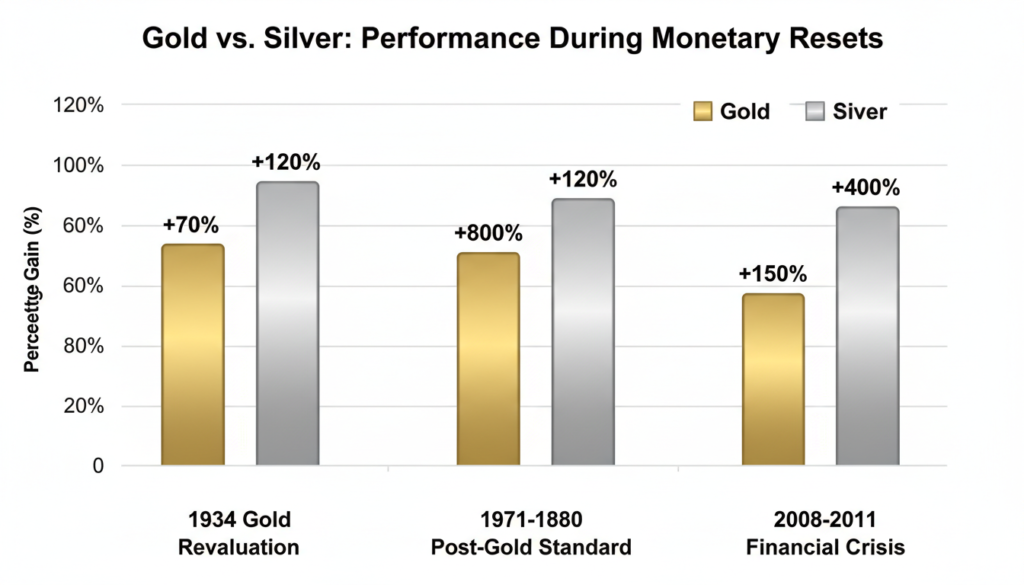
Gold vs Silver Behavior During Monetary Resets
While gold often takes center stage in discussions about monetary resets and repricing, silver’s role and behavior during such events deserves careful consideration. Historical patterns reveal important differences in how these two precious metals respond to monetary system changes.
Often outperforms gold percentage-wise during crises
Government Treatment
Often subject to controls, confiscation, or repricing
Typically faces fewer restrictions
Accessibility
Higher entry point for investment
More accessible to average investors
Historical examples provide insight into how these metals might behave during a potential 2026 repricing scenario:
1934 Gold Revaluation: When gold was repriced from $20.67 to $35, silver prices also rose significantly, from around $0.44 to $0.81 per ounce—an 84% increase compared to gold’s 69% rise.
1971-1980 Period: Following the end of the gold standard, silver outperformed gold percentage-wise, rising from $1.39 to a peak of $49.45 (3,450% increase) compared to gold’s rise from $35 to $850 (2,329% increase).
2008-2011 Financial Crisis: During this period of monetary uncertainty, silver rose from around $9 to nearly $50 (455% increase), while gold rose from about $700 to $1,900 (171% increase).
Common Myths and Misconceptions About Gold Repricing
Discussions about gold repricing often become clouded by misconceptions and myths. Clarifying these can help investors make more informed decisions about how to prepare for potential monetary changes in 2026 and beyond.
Facts About Gold Repricing
Repricing is primarily an accounting change to government balance sheets
Historical precedents exist, including the 1934 U.S. gold revaluation
Myth: Gold confiscation would necessarily accompany repricing
Myth: Only gold would be affected; other assets would be unimpacted
Myth: Repricing would solve all debt and currency problems permanently
Myth: Specific dates for repricing can be accurately predicted
Addressing Key Misconceptions
Misconception: “Gold repricing is just a conspiracy theory.”Reality: While timing predictions often prove incorrect, the concept of repricing is based on historical precedent and economic fundamentals. Governments have repriced gold numerous times throughout history when monetary conditions warranted.
Misconception: “A gold repricing would mean returning to the gold standard.”Reality: Repricing gold doesn’t necessarily mean returning to a full gold standard. It could instead involve incorporating gold as a partial reserve asset or using it to recalibrate currency values without direct convertibility.
Misconception: “Private gold ownership would be banned during repricing.”Reality: While the 1933 U.S. gold confiscation provides a concerning precedent, today’s global market and the smaller role of physical gold in the financial system make a repeat of such measures less likely, though not impossible.
Misconception: “Only physical gold would benefit from repricing.”Reality: While physical gold provides the most direct exposure to repricing benefits, mining stocks, certain ETFs, and other gold-related investments would also likely appreciate, though potentially with different dynamics.
Understanding these distinctions helps investors separate fact from fiction when evaluating the potential for gold repricing in 2026. While the exact timing and implementation of any repricing remain uncertain, the underlying economic conditions that would motivate such a move are observable and can inform prudent investment decisions.
Frequently Asked Questions About Gold Repricing
What exactly would happen if the U.S. government repriced gold in 2026?
If the U.S. government repriced gold in 2026, it would officially change the valuation of its gold reserves from the current .22 per ounce to a much higher figure, potentially thousands of dollars per ounce. This would be primarily an accounting change on the national balance sheet, instantly increasing the stated value of U.S. gold reserves.
The immediate effects would likely include improved debt-to-asset ratios for the government, potential strengthening of the dollar if the move restored confidence, and significant market reactions in gold and related assets. The repricing would not automatically change the market price of gold, but it would likely influence it substantially as markets adjusted to the new official valuation.
Could gold be confiscated again like it was in 1933?
While a repeat of the 1933 gold confiscation is possible, most analysts consider it less likely in today’s environment for several reasons. First, gold plays a much smaller role in the financial system now than it did during the Great Depression when the U.S. was still on the gold standard. Second, gold ownership is global and digital in many forms, making comprehensive confiscation more difficult to implement.
However, governments facing severe financial stress have historically taken extraordinary measures. Prudent investors might consider diversifying their gold holdings across different jurisdictions or ownership structures to mitigate this risk, while recognizing that no strategy provides absolute protection against determined government action.
How would a gold repricing affect the average investor’s portfolio?
A gold repricing would likely have cascading effects across multiple asset classes. Investors holding physical gold or gold-related investments would potentially see significant appreciation, though the exact relationship between official repricing and market prices is complex.
Portfolios with appropriate precious metals exposure would have some built-in hedge against the potential negative effects on traditional financial assets.
Why is 2026 specifically mentioned for potential gold repricing?
Several factors have led analysts to identify 2026 as a potential window for gold repricing:
Debt cycles and projected fiscal pressures are expected to intensify by 2026
The implementation timeline for Basel III banking regulations, which affect how banks treat gold as an asset, reaches completion around this period
Geopolitical realignments and dedollarization efforts are projected to reach critical mass in the mid-2020s
Historical monetary cycles suggest the current fiat system is approaching a potential inflection point
However, specific date predictions should be treated with caution. Economic and monetary transitions typically unfold over time rather than on precise schedules.
What’s the difference between owning physical gold and paper gold during a repricing?
During a gold repricing scenario, the distinction between physical gold and “paper gold” (ETFs, futures, unallocated accounts) could become critically important:
Aspect
Physical Gold
Paper Gold
Counterparty Risk
Minimal if directly owned and properly stored
Dependent on financial institutions, fund managers, or exchanges
Accessibility During Crisis
Directly accessible regardless of financial system status
May be subject to trading halts, redemption gates, or settlement issues
Regulatory Treatment
May be subject to reporting requirements or restrictions
Could face different regulatory treatment or forced settlement in currency
May trade at discount to physical during crisis; redemption may be restricted
Historical precedent suggests that during monetary stress, the gap between physical and paper gold prices can widen significantly, with physical commanding substantial premiums.
Birch Gold Group
Get the Free Precious Metals Information Kit
If you’re considering physical gold or silver, the free kit can help you understand options, process, and key considerations before you decide anything.
Preparing for Potential Gold Repricing: Prudent Steps for Investors
Whether or not a formal gold repricing occurs in 2026, the economic conditions that would prompt such an action are already present. Prudent investors might consider several steps to position themselves appropriately for either scenario.
Diversification with Physical Precious Metals: Allocating a portion of your portfolio to physical gold and silver provides direct exposure to potential repricing benefits while hedging against monetary uncertainty.
Understanding Historical Patterns: Studying past monetary transitions helps identify likely outcomes and appropriate protective measures.
Focusing on Wealth Preservation: During periods of monetary change, preserving purchasing power often takes precedence over generating returns.
Reducing Counterparty Risk: Minimizing dependence on financial intermediaries can be crucial if the banking system experiences stress during a monetary reset.
The discussion around gold repricing in 2026 ultimately highlights a broader truth: the current monetary system continues to evolve, and prudent investors adapt their strategies accordingly. Whether through dramatic repricing or gradual realignment, gold’s role in the global financial system appears poised for reassessment in the coming years.