
This site is reader supported and purchases made through the links may generate a commision.
Thanks for help supporting the site. Information only – not to be considered financial advice.
This article is reader supported and may pay affiliate commissions through the links. Thanks for supporting the blog! Informational only – not to be considered financial advice. If you need financial advice, speak to your financial advisor. For readers interested in diversifying their investments, a Gold IRA rollover guide might be helpful.
What Is a Gold IRA Rollover?
A Gold IRA rollover is the process of moving retirement funds from a traditional IRA, 401(k), or similar account into a Self-Directed IRA (SDIRA) that allows you to purchase and store physical precious metals like gold and silver. For those new to this process, a Gold IRA rollover guide can be invaluable in helping navigate the steps involved.
This strategy lets you diversify your retirement savings with tangible assets that can hedge against inflation, recession, or market volatility.
Unlike regular IRAs invested in stocks or bonds, a Gold IRA puts you in control of real, IRS-approved metal — stored securely on your behalf.
Who Qualifies for a Gold IRA Rollover?
You may be eligible for a tax-free rollover if you have:
- A 401(k) from a former employer
- A Traditional or Roth IRA
- A 403(b), 457(b), TSP, or similar plan
- An active 401(k) with in-service distribution rights
This company requires a $50,000 minimum investment.
Need a lower minimum? See our top companies list for more!
A rollover decision should begin with plan eligibility, tax handling, total fees, custody, and the role precious metals would play in the broader portfolio.

What to weigh before a Gold IRA rollover
A rollover changes the account structure and investment menu; it does not remove investment risk. Compare the existing plan’s expenses and protections with the proposed IRA’s administration, storage, insurance, dealer spread, shipping, distribution, and liquidation costs. Decide what allocation would serve a defined portfolio purpose, and keep adequate liquid assets outside the metals position.
Tax deferral generally continues only when the transaction and receiving account satisfy the applicable rules. A Roth conversion is different and can create current taxable income.
How the Gold IRA Rollover Process Works
Here’s a step-by-step breakdown of the process:
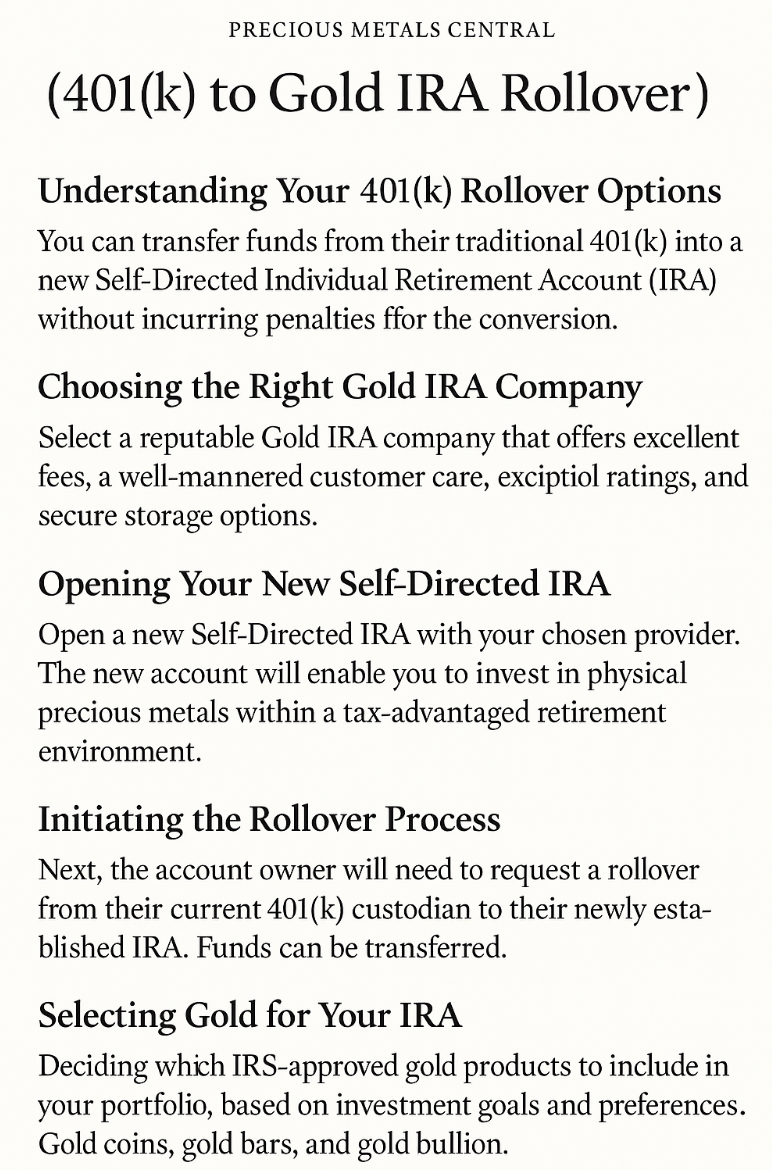
Step 1: Select a Trusted Gold IRA Company
You’ll need a Gold IRA specialist to walk you through setup, rules, and storage. Look for:
- High ratings on Trustpilot, BBB, and ConsumerAffairs
- Transparent pricing (beware of hidden fees)
- IRS-approved custodians and depositories
Find the Best Precious Metals Company to Fit your Needs
It’s all on the PreciousMetalsCentral.com list of the Best for 2026!

Step 2: Open a Self-Directed IRA (SDIRA)
Your new account must be a Self-Directed IRA, not a standard IRA. The Gold IRA company will help with paperwork and custodian coordination.
Step 3: Initiate the Rollover from Your 401(k) or IRA
You’ll work with your existing plan provider to initiate a direct rollover:
- Funds go directly from your old account to the SDIRA
- You avoid penalties and taxes
- Must be completed within 60 days if indirect
(Link to: How to Rollover 401k to a Gold IRA)
Step 4: Fund the SDIRA
Once transferred, your account is ready to purchase precious metals.
You’ll be able to allocate part or all of the rollover amount into IRS-approved metals.
Step 5: Choose IRS-Approved Metals
- Gold: American Gold Eagles, Canadian Maple Leafs, bars (.995+ purity)
- Silver: American Silver Eagles, bars (.999+)
- Platinum & Palladium: Also allowed under IRS rules
(Link to: IRS-Approved Gold and Silver Coins for IRAs)
Step 6: Store the Metals in a Secure Vault
IRS rules prohibit home storage. Instead:
- Metals are stored in an approved depository
- Common vaults include Delaware Depository, Brinks, and IDS Texas
- Your IRA maintains ownership; you receive statements and full audit tracking
What Are the Tax Implications?
The Gold IRA rollover is a non-taxable event — if done properly.
✔ Direct Rollover = No Tax
When funds move directly between custodians, you owe nothing.
✖ Indirect Rollover = Risk
If funds are sent to you personally, you must deposit them into the new account within 60 days — or face taxes and penalties.
(Always consult your tax advisor before acting.)
Contributions and rollovers are different
An annual IRA contribution is subject to tax-year limits and eligibility rules. A rollover moves eligible retirement money and is governed by separate distribution, withholding, timing, and receiving-plan rules. Do not use an annual contribution figure to decide how much can be rolled over; confirm the proposed amount with both institutions and a qualified tax professional.

How Long Does the Rollover Take?
| Phase | Estimated Time |
|---|---|
| Account setup | 1–3 business days |
| Rollover transfer | 5–10 business days |
| Precious metals purchase & vault delivery | 2–5 business days |
Total estimated time: 2–3 weeks
Are There Risks?
Yes — like any investment, there are risks to consider:
❗ Storage Fees
Expect annual fees between $100–$300 for secure depository storage.
❗ No Dividends
Precious metals don’t generate income — they preserve value.
❗ Illiquidity
Selling metals takes time (though good Gold IRA companies help with this).
(Link to: Gold IRA Pros and Cons in 2025)
Free Gold IRA Guide
Find the company path that fits your investment range
Answer two quick questions to see the Gold IRA company path matched to the amount you’re considering. No name, email, or phone number is required to view the result.
Benefits of Rolling Over into a Gold IRA
- ✅ Inflation hedge
- ✅ Safe-haven during crashes
- ✅ Tax-deferred retirement diversification
- ✅ Tangible, private asset ownership
- ✅ Ability to balance risk in portfolio
FAQs About Gold IRA Rollovers
Can I roll over a Roth 401(k)?
Yes — but it must go into a Roth SDIRA to maintain tax-free status.
Can I roll over more than once?
Yes — IRS rules allow one rollover per 12-month period per IRA. However, direct transfers between custodians are unlimited.
Can I take physical possession of the gold?
Only after retirement and distribution. Until then, metals must be stored in a qualified vault.
Do I have to rollover the full 401(k)?
No — you can roll over a portion while keeping the rest in other assets.
Final Thoughts: Is This Right for You?
A Gold IRA rollover isn’t for everyone. But if you:
- Want to protect your savings from inflation
- Worry about market instability
- Prefer owning real, tangible wealth
…it may be the smartest move for your retirement future.
In 2025, with rising debt, geopolitical risks, and fiat uncertainty, it makes sense to hedge your retirement with real gold. We hope you have enjoyed this gold IRA rollover guide.
📍 Start Your Rollover with a Trusted Provider
We’ve reviewed the top-rated Gold IRA companies based on fees, storage, customer support, and transparency.
👉 Compare the Best Gold IRA Companies Now