

Disclosure: This site is reader supported and purchases made through the links may generate a commision. Thanks for help supporting the site. Information only – not to be considered financial advice.
Where does this precious metal stand as we head into the new year? Retail spot sits at $66.01 per gram on Dec 26, 2025, and markets are watching whether the recent rally turns into lasting gains or slips back.
Heraeus points to early-2026 consolidation after strong 2025 moves. Lower real rates and steady inflation could lift investment demand. At the same time, weak industrial demand and recession risks might pressure supply and demand balances.
This piece will lay out a clear base case plus upside and downside scenarios. We’ll use the current context, fundamentals, and third-party forecasts to show what could move prices and why this metal behaves differently than gold.
Expect practical analysis aimed at U.S. investors: the drivers that matter, ranges analysts cite, scenario triggers, and common ways to gain exposure. This is a forward-looking view built on late-2025 data, so risk management and flexibility are key.
Urgent Update for 2026! Our Top Recommended Company: Metals Edge
Metals Edge Only Deals in BULLION, is a MARKET MAKER, and is a LICENSED, BONDED, and INSURED Floriday Corporation!
Metals Edge will NEVER Sell you Premium or Collectible Metals at Crazy Markups!
They are the best in FAIR PRICES, HONESTY, and CUSTOMER SERVICE.

Get the Metals Edge Investor Guide Right Away
Discover how investors use gold and silver to diversify retirement savings, reduce exposure to paper assets, and pursue more value through low-premium precious metals strategies.

Key Takeaways
- Retail spot was $66.01/gram on Dec 26, 2025, setting the starting point for scenarios.
- Lower real rates may boost investment, but weak auto demand can undercut gains.
- Behavior differs from gold because industrial cycles and catalysts dominate moves.
- Cross-metal flows with platinum matter and can shift investor focus quickly.
- This outlook uses fundamentals, supply signals, and forecasts to map ranges and risks.
Where Palladium Stands Heading Into 2026
Latest spot context: the retail quote sits at $66.01 per gram on Dec 26, 2025, placing the metal well above early-2025 lows but below the 2021 highs.
Recent swing and what it signals
The rally from $31.74/g on Jan 1, 2025 to $66.01/g (+107.99% YTD) shows sentiment and positioning can flip fast when markets price scarcity or substitution.

Multi-year snapshot
Compared with Jan 1, 2021 ($82.89/g) the metal is lower. It is roughly flat versus Jan 1, 2020 ($67.20/g) and up about 74% versus Jan 1, 2018 ($37.85/g).
Flat performance over time can mask sharp tradable swings. That volatility comes from changes in automotive build rates, recycling flows, and macro shifts more than any single headline.
- Rebound suggests shifting demand expectations.
- Forecasters will likely stay range-bound unless a clear supply shock, EV acceleration, or a cross-metal move in platinum forces repricing.
Practical question for U.S. investors: what specific changes in supply, demand, or policy would keep levels near today’s quote versus pushing back to prior extremes?
Fundamentals That Will Shape the Palladium Market in 2026
Automotive catalyst demand remains the single largest driver shaping the metal’s fundamentals. About 85% of use goes into converters, so shifts in ICE and hybrid production move balances fast.
Our Top Recommended Precious Metals Companies for 2026
Best Precious Metals Companies of 2026
Full rankings • Fee breakdowns • IRA & physical metals analysis
Get more detailed information at our Top Precious Metals Companies List of 2026 Page
Auto anchor and the BEV debate
Faster electrification cuts loading per vehicle over time. Yet hybrids and a large ICE fleet keep near-term demand meaningful. That creates a push-pull that can swing the price quickly.
Industrial and future-option uses
Electronics, sensors, plating and dentistry form a steady base. Fuel cells and hydrogen are optional upside if policy and deployment accelerate, especially in Asia.
“Small supply shifts can flip the market from deficit to surplus, and that volatility is the market’s core feature.”
| Factor | Role | Impact Sensitivity |
|---|---|---|
| Automotive demand | Primary anchor (~85%) | High |
| Primary supply | Concentrated (Russia, South Africa) | High |
| Recycling | Secondary swing supply | Medium–High |
| Industrial uses | Baseline consumption | Medium |
Most miners produce this metal as a byproduct of nickel, copper or platinum mining, so production often lags dedicated signals. Analysts differ mainly on BEV share, recycling speed, and industrial resilience—these are the variables that change the next year’s forecast.
palladium price outlook 2026: Base Case Forecast Range and What Could Break It
Analyst models split on direction, with one camp seeing a softer market and the other warning of upside risk tied to substitution and flows.
Base-case range: Combine the two published views and you get a working U.S. range from roughly $950 to $1,500 per ounce on the one hand, and a glide path toward about $1,150 per ounce by late year on the other. These are forecasts, not guarantees.
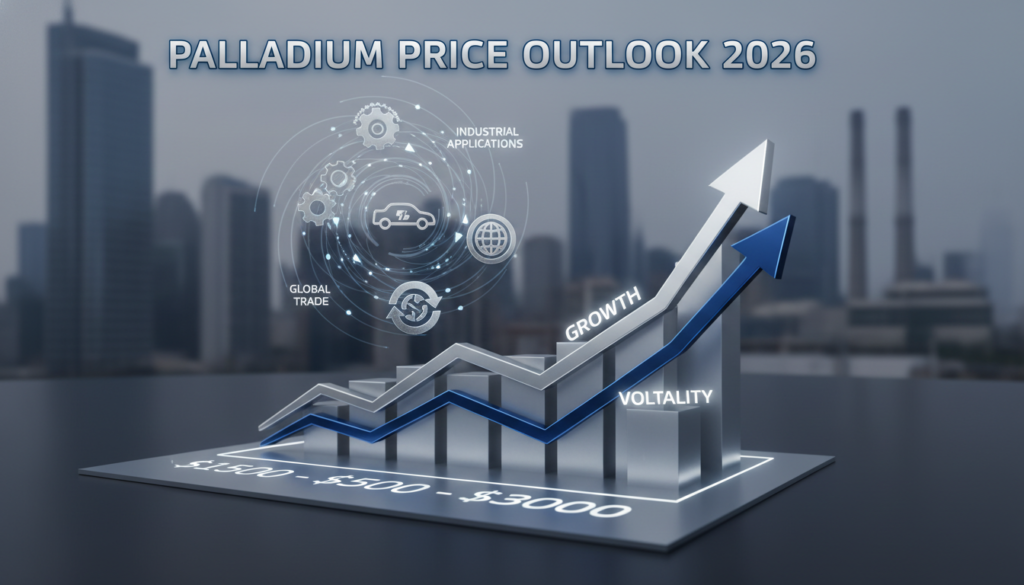
Heraeus expects a potential surplus as EVs gain share, listing a $950–$1,500/oz window and noting that a renewed platinum rally could lift values above model levels.
Metals Focus is more bearish, projecting a fall toward ~$1,150 by Q4 and a narrower deficit as recycling recovers and auto demand softens.
“Small differences in BEV penetration, scrap recovery and industrial activity explain most of the forecast gap.”
- Why forecasts diverge: assumptions on BEV share, recycling rates, and industrial resilience.
- Breaker variables: a strong platinum move, lower real rates or inflation shocks, or a sharp recession.
- Range integrity check: to breach the top, expect tighter supply, weaker scrap; to fall below the low end, expect faster EV adoption and stronger secondary flows.
Comeback vs Collapse Scenarios for Palladium Prices in 2026
A sudden supply shock or policy tweak can flip the market from calm to tight in weeks.
Comeback pathway
Supply disruptions—a major mine outage or export limits from Russia or South Africa—could remove metal quickly from the system.
Investor flows tied to gold or broader precious metals can then add demand, lifting the price even if auto demand lagged.
Collapse pathway
Faster BEV adoption, stronger recycling, and weaker industrial activity form a clear collapse route.
If scrap recovery accelerates and automotive loading falls, the market can move back toward the lower analyst band.
Cross-metal and US geopolitical wildcards
A renewed platinum rally can trigger substitution and repositioning between the metals, creating spillovers in the platinum palladium trade.
U.S. risks—tariffs, the Section 232 review, and anti-dumping actions—can alter Russian flows and local premiums fast.
“Watch auto build rates, scrap volumes, platinum momentum, and policy headlines to read probabilities rather than to predict a single outcome.”
| Scenario | Key triggers | Likely direction vs forecast band |
|---|---|---|
| Comeback | Mine outage, tariffs, precious-metal inflows | Push above upper band |
| Collapse | Rapid BEV gains, high recycling, soft industry | Slide toward lower band |
| Cross-metal spill | Platinum rally & substitution | Volatile rebalancing |
How US Investors Can Use This Report to Guide Palladium Investment Decisions
This report translates market signals into concrete steps U.S. investors can use when choosing exposure. Use the scenarios and forecast bands to match time horizon, risk tolerance, and instrument choice.
Physical basics: bars, coins, purity and storage
Ownership means buying bars or coins from reputable dealers and verifying investment-grade purity (commonly 99.95%+). Authentication matters; ask for assay certificates.
Costs include spreads, storage fees, and insurance. Physical holdings often trade at a different price than headlines, especially during fast moves.

This company requires a $50,000 minimum investment.
Need a lower minimum? See our top companies list for more!
Paper exposure: futures, volatility and risk controls
Futures and ETFs offer efficient exposure but bring margin risk and higher short-term volatility. Use small position sizes and defined stop-losses during consolidation phases.
When the market looks range-bound, consider layered entries and hedges rather than single large bets.
Portfolio framing: pairing with gold and platinum
Add metal exposure with clear intent: defensive (gold), cyclical (platinum), or diversified (mix). Correlations shift when auto demand or supply shocks hit the sector.
| Goal | Instrument | Simple rule |
|---|---|---|
| Long-term hold | Physical bars/coins | Buy quality, secure storage |
| Speculation / hedge | Futures or ETFs | Limit size, set stops |
| Diversify existing platinum | Blend positions | Balance auto-cycle exposure |
Conclusion
Heading into the new year, the market sits on a tight hinge between structural shifts and headline risks.
The report anchors on $66.01/g (Dec 26, 2025) and the strong rebound from $31.74/g (+107.99% YTD). Analysts offer a split forecast: Heraeus lists about $950–$1,500/oz, while Metals Focus centers near $1,150 by Q4.
One path is a sharp comeback if supply tightens or platinum momentum drags the complex higher. The other is a collapse driven by faster BEV adoption and stronger recycling that eases any deficit.
Practical takeaway: treat this metal as high volatility—position size, horizon, and instrument choice matter most for U.S. investors.
Watch these through the year: auto production and BEV share; recycling recovery; Russia/South Africa disruptions; and platinum market momentum.
FAQ
What is the current spot level and recent performance trend heading into 2026?
Which sectors drive demand and how much do they account for?
How do electric vehicles affect future demand?
What are the main supply risks and sources?
How important is recycling for market balance?
What do major analyst houses forecast for 2026 and why do they differ?
What is the current spot level and recent performance trend heading into 2026?
Which sectors drive demand and how much do they account for?
How do electric vehicles affect future demand?
What are the main supply risks and sources?
How important is recycling for market balance?
What do major analyst houses forecast for 2026 and why do they differ?
FAQ
What is the current spot level and recent performance trend heading into 2026?
As of Dec 26, 2025 the latest spot was .01 per gram. The metal rebounded sharply during 2025, climbing from about .74/g at the start of the year for a roughly +108% year-to-date gain, reflecting a volatile recovery after earlier multi-year weakness.
Which sectors drive demand and how much do they account for?
Automotive catalytic converters anchor demand, accounting for roughly 85% of consumption. Other uses include electronics, sensors, chemical catalysts, and dental alloys. Emerging areas like fuel cells and hydrogen projects could add upside if scaled.
How do electric vehicles affect future demand?
Battery electric vehicles reduce the need for catalytic converters and therefore lower auto demand. The net effect depends on ICE production trends, plug-in hybrid volumes, and the pace of fleet turnover. Faster BEV adoption is the main risk to sustained demand.
What are the main supply risks and sources?
Primary output is concentrated in Russia and South Africa, which together produce over 80% of mined metal — a concentration risk for disruptions. Much supply is a byproduct of nickel, copper, lead or platinum mining, so those markets’ cycles also influence output.
How important is recycling for market balance?
Recycling from spent catalytic converters is a critical swing factor. Improved collection and recovery can significantly boost secondary supply and ease deficits, while weak recycling keeps tightness and supports higher quotes.
What do major analyst houses forecast for 2026 and why do they differ?
Views vary. Some projections suggest a widening surplus with prices in a wide band around 0–
FAQ
What is the current spot level and recent performance trend heading into 2026?
As of Dec 26, 2025 the latest spot was $66.01 per gram. The metal rebounded sharply during 2025, climbing from about $31.74/g at the start of the year for a roughly +108% year-to-date gain, reflecting a volatile recovery after earlier multi-year weakness.
Which sectors drive demand and how much do they account for?
Automotive catalytic converters anchor demand, accounting for roughly 85% of consumption. Other uses include electronics, sensors, chemical catalysts, and dental alloys. Emerging areas like fuel cells and hydrogen projects could add upside if scaled.
How do electric vehicles affect future demand?
Battery electric vehicles reduce the need for catalytic converters and therefore lower auto demand. The net effect depends on ICE production trends, plug-in hybrid volumes, and the pace of fleet turnover. Faster BEV adoption is the main risk to sustained demand.
What are the main supply risks and sources?
Primary output is concentrated in Russia and South Africa, which together produce over 80% of mined metal — a concentration risk for disruptions. Much supply is a byproduct of nickel, copper, lead or platinum mining, so those markets’ cycles also influence output.
How important is recycling for market balance?
Recycling from spent catalytic converters is a critical swing factor. Improved collection and recovery can significantly boost secondary supply and ease deficits, while weak recycling keeps tightness and supports higher quotes.
What do major analyst houses forecast for 2026 and why do they differ?
Views vary. Some projections suggest a widening surplus with prices in a wide band around $950–$1,500 per ounce, while others expect softer levels near $1,150 by late 2026. Differences stem from assumptions on BEV adoption, recycling rates, industrial strength, and potential supply disruptions.
What are the comeback and collapse scenarios investors should consider?
A comeback can occur if supply disruptions hit major producers, recycling lags, or if investors rotate back into precious metals. A collapse could follow rapid BEV adoption, a strong recovery in recycling, or weaker industrial use. Cross-metal moves, especially platinum rallies, can also reshuffle demand via substitution.
How can U.S. investors gain exposure and manage risks?
Options include physical bullion (bars, coins) with attention to purity and storage; futures or ETFs for paper exposure, though these carry margin and counterparty risk; and using position sizing and stops to handle volatility. Compare holdings with gold and platinum for portfolio context.
What geopolitical factors could create surprises for U.S. markets?
Tariffs, trade restrictions, investigations like Section 232, and changes to Russian metal flows can quickly alter supply availability and market sentiment. Sanctions or export curbs are the primary wildcards to monitor.
How should investors interpret multi-year comparisons versus 2018–2021 levels?
The metal is down from peak 2021 levels, roughly flat versus early 2020, and higher than January 2018. These comparisons show how cyclical demand, pandemic effects, and supply shocks have shifted the market, so investors should weigh both short-term momentum and longer-term fundamentals.
,500 per ounce, while others expect softer levels near
FAQ
What is the current spot level and recent performance trend heading into 2026?
As of Dec 26, 2025 the latest spot was $66.01 per gram. The metal rebounded sharply during 2025, climbing from about $31.74/g at the start of the year for a roughly +108% year-to-date gain, reflecting a volatile recovery after earlier multi-year weakness.
Which sectors drive demand and how much do they account for?
Automotive catalytic converters anchor demand, accounting for roughly 85% of consumption. Other uses include electronics, sensors, chemical catalysts, and dental alloys. Emerging areas like fuel cells and hydrogen projects could add upside if scaled.
How do electric vehicles affect future demand?
Battery electric vehicles reduce the need for catalytic converters and therefore lower auto demand. The net effect depends on ICE production trends, plug-in hybrid volumes, and the pace of fleet turnover. Faster BEV adoption is the main risk to sustained demand.
What are the main supply risks and sources?
Primary output is concentrated in Russia and South Africa, which together produce over 80% of mined metal — a concentration risk for disruptions. Much supply is a byproduct of nickel, copper, lead or platinum mining, so those markets’ cycles also influence output.
How important is recycling for market balance?
Recycling from spent catalytic converters is a critical swing factor. Improved collection and recovery can significantly boost secondary supply and ease deficits, while weak recycling keeps tightness and supports higher quotes.
What do major analyst houses forecast for 2026 and why do they differ?
Views vary. Some projections suggest a widening surplus with prices in a wide band around $950–$1,500 per ounce, while others expect softer levels near $1,150 by late 2026. Differences stem from assumptions on BEV adoption, recycling rates, industrial strength, and potential supply disruptions.
What are the comeback and collapse scenarios investors should consider?
A comeback can occur if supply disruptions hit major producers, recycling lags, or if investors rotate back into precious metals. A collapse could follow rapid BEV adoption, a strong recovery in recycling, or weaker industrial use. Cross-metal moves, especially platinum rallies, can also reshuffle demand via substitution.
How can U.S. investors gain exposure and manage risks?
Options include physical bullion (bars, coins) with attention to purity and storage; futures or ETFs for paper exposure, though these carry margin and counterparty risk; and using position sizing and stops to handle volatility. Compare holdings with gold and platinum for portfolio context.
What geopolitical factors could create surprises for U.S. markets?
Tariffs, trade restrictions, investigations like Section 232, and changes to Russian metal flows can quickly alter supply availability and market sentiment. Sanctions or export curbs are the primary wildcards to monitor.
How should investors interpret multi-year comparisons versus 2018–2021 levels?
The metal is down from peak 2021 levels, roughly flat versus early 2020, and higher than January 2018. These comparisons show how cyclical demand, pandemic effects, and supply shocks have shifted the market, so investors should weigh both short-term momentum and longer-term fundamentals.
,150 by late 2026. Differences stem from assumptions on BEV adoption, recycling rates, industrial strength, and potential supply disruptions.
What are the comeback and collapse scenarios investors should consider?
A comeback can occur if supply disruptions hit major producers, recycling lags, or if investors rotate back into precious metals. A collapse could follow rapid BEV adoption, a strong recovery in recycling, or weaker industrial use. Cross-metal moves, especially platinum rallies, can also reshuffle demand via substitution.
How can U.S. investors gain exposure and manage risks?
Options include physical bullion (bars, coins) with attention to purity and storage; futures or ETFs for paper exposure, though these carry margin and counterparty risk; and using position sizing and stops to handle volatility. Compare holdings with gold and platinum for portfolio context.
What geopolitical factors could create surprises for U.S. markets?
Tariffs, trade restrictions, investigations like Section 232, and changes to Russian metal flows can quickly alter supply availability and market sentiment. Sanctions or export curbs are the primary wildcards to monitor.
How should investors interpret multi-year comparisons versus 2018–2021 levels?
The metal is down from peak 2021 levels, roughly flat versus early 2020, and higher than January 2018. These comparisons show how cyclical demand, pandemic effects, and supply shocks have shifted the market, so investors should weigh both short-term momentum and longer-term fundamentals.
FAQ
What is the current spot level and recent performance trend heading into 2026?
As of Dec 26, 2025 the latest spot was .01 per gram. The metal rebounded sharply during 2025, climbing from about .74/g at the start of the year for a roughly +108% year-to-date gain, reflecting a volatile recovery after earlier multi-year weakness.
Which sectors drive demand and how much do they account for?
Automotive catalytic converters anchor demand, accounting for roughly 85% of consumption. Other uses include electronics, sensors, chemical catalysts, and dental alloys. Emerging areas like fuel cells and hydrogen projects could add upside if scaled.
How do electric vehicles affect future demand?
Battery electric vehicles reduce the need for catalytic converters and therefore lower auto demand. The net effect depends on ICE production trends, plug-in hybrid volumes, and the pace of fleet turnover. Faster BEV adoption is the main risk to sustained demand.
What are the main supply risks and sources?
Primary output is concentrated in Russia and South Africa, which together produce over 80% of mined metal — a concentration risk for disruptions. Much supply is a byproduct of nickel, copper, lead or platinum mining, so those markets’ cycles also influence output.
How important is recycling for market balance?
Recycling from spent catalytic converters is a critical swing factor. Improved collection and recovery can significantly boost secondary supply and ease deficits, while weak recycling keeps tightness and supports higher quotes.
What do major analyst houses forecast for 2026 and why do they differ?
Views vary. Some projections suggest a widening surplus with prices in a wide band around 0–
FAQ
What is the current spot level and recent performance trend heading into 2026?
As of Dec 26, 2025 the latest spot was $66.01 per gram. The metal rebounded sharply during 2025, climbing from about $31.74/g at the start of the year for a roughly +108% year-to-date gain, reflecting a volatile recovery after earlier multi-year weakness.
Which sectors drive demand and how much do they account for?
Automotive catalytic converters anchor demand, accounting for roughly 85% of consumption. Other uses include electronics, sensors, chemical catalysts, and dental alloys. Emerging areas like fuel cells and hydrogen projects could add upside if scaled.
How do electric vehicles affect future demand?
Battery electric vehicles reduce the need for catalytic converters and therefore lower auto demand. The net effect depends on ICE production trends, plug-in hybrid volumes, and the pace of fleet turnover. Faster BEV adoption is the main risk to sustained demand.
What are the main supply risks and sources?
Primary output is concentrated in Russia and South Africa, which together produce over 80% of mined metal — a concentration risk for disruptions. Much supply is a byproduct of nickel, copper, lead or platinum mining, so those markets’ cycles also influence output.
How important is recycling for market balance?
Recycling from spent catalytic converters is a critical swing factor. Improved collection and recovery can significantly boost secondary supply and ease deficits, while weak recycling keeps tightness and supports higher quotes.
What do major analyst houses forecast for 2026 and why do they differ?
Views vary. Some projections suggest a widening surplus with prices in a wide band around $950–$1,500 per ounce, while others expect softer levels near $1,150 by late 2026. Differences stem from assumptions on BEV adoption, recycling rates, industrial strength, and potential supply disruptions.
What are the comeback and collapse scenarios investors should consider?
A comeback can occur if supply disruptions hit major producers, recycling lags, or if investors rotate back into precious metals. A collapse could follow rapid BEV adoption, a strong recovery in recycling, or weaker industrial use. Cross-metal moves, especially platinum rallies, can also reshuffle demand via substitution.
How can U.S. investors gain exposure and manage risks?
Options include physical bullion (bars, coins) with attention to purity and storage; futures or ETFs for paper exposure, though these carry margin and counterparty risk; and using position sizing and stops to handle volatility. Compare holdings with gold and platinum for portfolio context.
What geopolitical factors could create surprises for U.S. markets?
Tariffs, trade restrictions, investigations like Section 232, and changes to Russian metal flows can quickly alter supply availability and market sentiment. Sanctions or export curbs are the primary wildcards to monitor.
How should investors interpret multi-year comparisons versus 2018–2021 levels?
The metal is down from peak 2021 levels, roughly flat versus early 2020, and higher than January 2018. These comparisons show how cyclical demand, pandemic effects, and supply shocks have shifted the market, so investors should weigh both short-term momentum and longer-term fundamentals.
,500 per ounce, while others expect softer levels near
FAQ
What is the current spot level and recent performance trend heading into 2026?
As of Dec 26, 2025 the latest spot was $66.01 per gram. The metal rebounded sharply during 2025, climbing from about $31.74/g at the start of the year for a roughly +108% year-to-date gain, reflecting a volatile recovery after earlier multi-year weakness.
Which sectors drive demand and how much do they account for?
Automotive catalytic converters anchor demand, accounting for roughly 85% of consumption. Other uses include electronics, sensors, chemical catalysts, and dental alloys. Emerging areas like fuel cells and hydrogen projects could add upside if scaled.
How do electric vehicles affect future demand?
Battery electric vehicles reduce the need for catalytic converters and therefore lower auto demand. The net effect depends on ICE production trends, plug-in hybrid volumes, and the pace of fleet turnover. Faster BEV adoption is the main risk to sustained demand.
What are the main supply risks and sources?
Primary output is concentrated in Russia and South Africa, which together produce over 80% of mined metal — a concentration risk for disruptions. Much supply is a byproduct of nickel, copper, lead or platinum mining, so those markets’ cycles also influence output.
How important is recycling for market balance?
Recycling from spent catalytic converters is a critical swing factor. Improved collection and recovery can significantly boost secondary supply and ease deficits, while weak recycling keeps tightness and supports higher quotes.
What do major analyst houses forecast for 2026 and why do they differ?
Views vary. Some projections suggest a widening surplus with prices in a wide band around $950–$1,500 per ounce, while others expect softer levels near $1,150 by late 2026. Differences stem from assumptions on BEV adoption, recycling rates, industrial strength, and potential supply disruptions.
What are the comeback and collapse scenarios investors should consider?
A comeback can occur if supply disruptions hit major producers, recycling lags, or if investors rotate back into precious metals. A collapse could follow rapid BEV adoption, a strong recovery in recycling, or weaker industrial use. Cross-metal moves, especially platinum rallies, can also reshuffle demand via substitution.
How can U.S. investors gain exposure and manage risks?
Options include physical bullion (bars, coins) with attention to purity and storage; futures or ETFs for paper exposure, though these carry margin and counterparty risk; and using position sizing and stops to handle volatility. Compare holdings with gold and platinum for portfolio context.
What geopolitical factors could create surprises for U.S. markets?
Tariffs, trade restrictions, investigations like Section 232, and changes to Russian metal flows can quickly alter supply availability and market sentiment. Sanctions or export curbs are the primary wildcards to monitor.
How should investors interpret multi-year comparisons versus 2018–2021 levels?
The metal is down from peak 2021 levels, roughly flat versus early 2020, and higher than January 2018. These comparisons show how cyclical demand, pandemic effects, and supply shocks have shifted the market, so investors should weigh both short-term momentum and longer-term fundamentals.
,150 by late 2026. Differences stem from assumptions on BEV adoption, recycling rates, industrial strength, and potential supply disruptions.
What are the comeback and collapse scenarios investors should consider?
A comeback can occur if supply disruptions hit major producers, recycling lags, or if investors rotate back into precious metals. A collapse could follow rapid BEV adoption, a strong recovery in recycling, or weaker industrial use. Cross-metal moves, especially platinum rallies, can also reshuffle demand via substitution.
How can U.S. investors gain exposure and manage risks?
Options include physical bullion (bars, coins) with attention to purity and storage; futures or ETFs for paper exposure, though these carry margin and counterparty risk; and using position sizing and stops to handle volatility. Compare holdings with gold and platinum for portfolio context.
What geopolitical factors could create surprises for U.S. markets?
Tariffs, trade restrictions, investigations like Section 232, and changes to Russian metal flows can quickly alter supply availability and market sentiment. Sanctions or export curbs are the primary wildcards to monitor.
How should investors interpret multi-year comparisons versus 2018–2021 levels?
The metal is down from peak 2021 levels, roughly flat versus early 2020, and higher than January 2018. These comparisons show how cyclical demand, pandemic effects, and supply shocks have shifted the market, so investors should weigh both short-term momentum and longer-term fundamentals.
What are the comeback and collapse scenarios investors should consider?
How can U.S. investors gain exposure and manage risks?
What geopolitical factors could create surprises for U.S. markets?
How should investors interpret multi-year comparisons versus 2018–2021 levels?
What is the current spot level and recent performance trend heading into 2026?
Which sectors drive demand and how much do they account for?
How do electric vehicles affect future demand?
What are the main supply risks and sources?
How important is recycling for market balance?
What do major analyst houses forecast for 2026 and why do they differ?
FAQ
What is the current spot level and recent performance trend heading into 2026?
As of Dec 26, 2025 the latest spot was .01 per gram. The metal rebounded sharply during 2025, climbing from about .74/g at the start of the year for a roughly +108% year-to-date gain, reflecting a volatile recovery after earlier multi-year weakness.
Which sectors drive demand and how much do they account for?
Automotive catalytic converters anchor demand, accounting for roughly 85% of consumption. Other uses include electronics, sensors, chemical catalysts, and dental alloys. Emerging areas like fuel cells and hydrogen projects could add upside if scaled.
How do electric vehicles affect future demand?
Battery electric vehicles reduce the need for catalytic converters and therefore lower auto demand. The net effect depends on ICE production trends, plug-in hybrid volumes, and the pace of fleet turnover. Faster BEV adoption is the main risk to sustained demand.
What are the main supply risks and sources?
Primary output is concentrated in Russia and South Africa, which together produce over 80% of mined metal — a concentration risk for disruptions. Much supply is a byproduct of nickel, copper, lead or platinum mining, so those markets’ cycles also influence output.
How important is recycling for market balance?
Recycling from spent catalytic converters is a critical swing factor. Improved collection and recovery can significantly boost secondary supply and ease deficits, while weak recycling keeps tightness and supports higher quotes.
What do major analyst houses forecast for 2026 and why do they differ?
Views vary. Some projections suggest a widening surplus with prices in a wide band around 0–
FAQ
What is the current spot level and recent performance trend heading into 2026?
As of Dec 26, 2025 the latest spot was $66.01 per gram. The metal rebounded sharply during 2025, climbing from about $31.74/g at the start of the year for a roughly +108% year-to-date gain, reflecting a volatile recovery after earlier multi-year weakness.
Which sectors drive demand and how much do they account for?
Automotive catalytic converters anchor demand, accounting for roughly 85% of consumption. Other uses include electronics, sensors, chemical catalysts, and dental alloys. Emerging areas like fuel cells and hydrogen projects could add upside if scaled.
How do electric vehicles affect future demand?
Battery electric vehicles reduce the need for catalytic converters and therefore lower auto demand. The net effect depends on ICE production trends, plug-in hybrid volumes, and the pace of fleet turnover. Faster BEV adoption is the main risk to sustained demand.
What are the main supply risks and sources?
Primary output is concentrated in Russia and South Africa, which together produce over 80% of mined metal — a concentration risk for disruptions. Much supply is a byproduct of nickel, copper, lead or platinum mining, so those markets’ cycles also influence output.
How important is recycling for market balance?
Recycling from spent catalytic converters is a critical swing factor. Improved collection and recovery can significantly boost secondary supply and ease deficits, while weak recycling keeps tightness and supports higher quotes.
What do major analyst houses forecast for 2026 and why do they differ?
Views vary. Some projections suggest a widening surplus with prices in a wide band around $950–$1,500 per ounce, while others expect softer levels near $1,150 by late 2026. Differences stem from assumptions on BEV adoption, recycling rates, industrial strength, and potential supply disruptions.
What are the comeback and collapse scenarios investors should consider?
A comeback can occur if supply disruptions hit major producers, recycling lags, or if investors rotate back into precious metals. A collapse could follow rapid BEV adoption, a strong recovery in recycling, or weaker industrial use. Cross-metal moves, especially platinum rallies, can also reshuffle demand via substitution.
How can U.S. investors gain exposure and manage risks?
Options include physical bullion (bars, coins) with attention to purity and storage; futures or ETFs for paper exposure, though these carry margin and counterparty risk; and using position sizing and stops to handle volatility. Compare holdings with gold and platinum for portfolio context.
What geopolitical factors could create surprises for U.S. markets?
Tariffs, trade restrictions, investigations like Section 232, and changes to Russian metal flows can quickly alter supply availability and market sentiment. Sanctions or export curbs are the primary wildcards to monitor.
How should investors interpret multi-year comparisons versus 2018–2021 levels?
The metal is down from peak 2021 levels, roughly flat versus early 2020, and higher than January 2018. These comparisons show how cyclical demand, pandemic effects, and supply shocks have shifted the market, so investors should weigh both short-term momentum and longer-term fundamentals.
,500 per ounce, while others expect softer levels near
FAQ
What is the current spot level and recent performance trend heading into 2026?
As of Dec 26, 2025 the latest spot was $66.01 per gram. The metal rebounded sharply during 2025, climbing from about $31.74/g at the start of the year for a roughly +108% year-to-date gain, reflecting a volatile recovery after earlier multi-year weakness.
Which sectors drive demand and how much do they account for?
Automotive catalytic converters anchor demand, accounting for roughly 85% of consumption. Other uses include electronics, sensors, chemical catalysts, and dental alloys. Emerging areas like fuel cells and hydrogen projects could add upside if scaled.
How do electric vehicles affect future demand?
Battery electric vehicles reduce the need for catalytic converters and therefore lower auto demand. The net effect depends on ICE production trends, plug-in hybrid volumes, and the pace of fleet turnover. Faster BEV adoption is the main risk to sustained demand.
What are the main supply risks and sources?
Primary output is concentrated in Russia and South Africa, which together produce over 80% of mined metal — a concentration risk for disruptions. Much supply is a byproduct of nickel, copper, lead or platinum mining, so those markets’ cycles also influence output.
How important is recycling for market balance?
Recycling from spent catalytic converters is a critical swing factor. Improved collection and recovery can significantly boost secondary supply and ease deficits, while weak recycling keeps tightness and supports higher quotes.
What do major analyst houses forecast for 2026 and why do they differ?
Views vary. Some projections suggest a widening surplus with prices in a wide band around $950–$1,500 per ounce, while others expect softer levels near $1,150 by late 2026. Differences stem from assumptions on BEV adoption, recycling rates, industrial strength, and potential supply disruptions.
What are the comeback and collapse scenarios investors should consider?
A comeback can occur if supply disruptions hit major producers, recycling lags, or if investors rotate back into precious metals. A collapse could follow rapid BEV adoption, a strong recovery in recycling, or weaker industrial use. Cross-metal moves, especially platinum rallies, can also reshuffle demand via substitution.
How can U.S. investors gain exposure and manage risks?
Options include physical bullion (bars, coins) with attention to purity and storage; futures or ETFs for paper exposure, though these carry margin and counterparty risk; and using position sizing and stops to handle volatility. Compare holdings with gold and platinum for portfolio context.
What geopolitical factors could create surprises for U.S. markets?
Tariffs, trade restrictions, investigations like Section 232, and changes to Russian metal flows can quickly alter supply availability and market sentiment. Sanctions or export curbs are the primary wildcards to monitor.
How should investors interpret multi-year comparisons versus 2018–2021 levels?
The metal is down from peak 2021 levels, roughly flat versus early 2020, and higher than January 2018. These comparisons show how cyclical demand, pandemic effects, and supply shocks have shifted the market, so investors should weigh both short-term momentum and longer-term fundamentals.
,150 by late 2026. Differences stem from assumptions on BEV adoption, recycling rates, industrial strength, and potential supply disruptions.
What are the comeback and collapse scenarios investors should consider?
A comeback can occur if supply disruptions hit major producers, recycling lags, or if investors rotate back into precious metals. A collapse could follow rapid BEV adoption, a strong recovery in recycling, or weaker industrial use. Cross-metal moves, especially platinum rallies, can also reshuffle demand via substitution.
How can U.S. investors gain exposure and manage risks?
Options include physical bullion (bars, coins) with attention to purity and storage; futures or ETFs for paper exposure, though these carry margin and counterparty risk; and using position sizing and stops to handle volatility. Compare holdings with gold and platinum for portfolio context.
What geopolitical factors could create surprises for U.S. markets?
Tariffs, trade restrictions, investigations like Section 232, and changes to Russian metal flows can quickly alter supply availability and market sentiment. Sanctions or export curbs are the primary wildcards to monitor.
How should investors interpret multi-year comparisons versus 2018–2021 levels?
The metal is down from peak 2021 levels, roughly flat versus early 2020, and higher than January 2018. These comparisons show how cyclical demand, pandemic effects, and supply shocks have shifted the market, so investors should weigh both short-term momentum and longer-term fundamentals.
FAQ
What is the current spot level and recent performance trend heading into 2026?
As of Dec 26, 2025 the latest spot was .01 per gram. The metal rebounded sharply during 2025, climbing from about .74/g at the start of the year for a roughly +108% year-to-date gain, reflecting a volatile recovery after earlier multi-year weakness.
Which sectors drive demand and how much do they account for?
Automotive catalytic converters anchor demand, accounting for roughly 85% of consumption. Other uses include electronics, sensors, chemical catalysts, and dental alloys. Emerging areas like fuel cells and hydrogen projects could add upside if scaled.
How do electric vehicles affect future demand?
Battery electric vehicles reduce the need for catalytic converters and therefore lower auto demand. The net effect depends on ICE production trends, plug-in hybrid volumes, and the pace of fleet turnover. Faster BEV adoption is the main risk to sustained demand.
What are the main supply risks and sources?
Primary output is concentrated in Russia and South Africa, which together produce over 80% of mined metal — a concentration risk for disruptions. Much supply is a byproduct of nickel, copper, lead or platinum mining, so those markets’ cycles also influence output.
How important is recycling for market balance?
Recycling from spent catalytic converters is a critical swing factor. Improved collection and recovery can significantly boost secondary supply and ease deficits, while weak recycling keeps tightness and supports higher quotes.
What do major analyst houses forecast for 2026 and why do they differ?
Views vary. Some projections suggest a widening surplus with prices in a wide band around 0–
FAQ
What is the current spot level and recent performance trend heading into 2026?
As of Dec 26, 2025 the latest spot was $66.01 per gram. The metal rebounded sharply during 2025, climbing from about $31.74/g at the start of the year for a roughly +108% year-to-date gain, reflecting a volatile recovery after earlier multi-year weakness.
Which sectors drive demand and how much do they account for?
Automotive catalytic converters anchor demand, accounting for roughly 85% of consumption. Other uses include electronics, sensors, chemical catalysts, and dental alloys. Emerging areas like fuel cells and hydrogen projects could add upside if scaled.
How do electric vehicles affect future demand?
Battery electric vehicles reduce the need for catalytic converters and therefore lower auto demand. The net effect depends on ICE production trends, plug-in hybrid volumes, and the pace of fleet turnover. Faster BEV adoption is the main risk to sustained demand.
What are the main supply risks and sources?
Primary output is concentrated in Russia and South Africa, which together produce over 80% of mined metal — a concentration risk for disruptions. Much supply is a byproduct of nickel, copper, lead or platinum mining, so those markets’ cycles also influence output.
How important is recycling for market balance?
Recycling from spent catalytic converters is a critical swing factor. Improved collection and recovery can significantly boost secondary supply and ease deficits, while weak recycling keeps tightness and supports higher quotes.
What do major analyst houses forecast for 2026 and why do they differ?
Views vary. Some projections suggest a widening surplus with prices in a wide band around $950–$1,500 per ounce, while others expect softer levels near $1,150 by late 2026. Differences stem from assumptions on BEV adoption, recycling rates, industrial strength, and potential supply disruptions.
What are the comeback and collapse scenarios investors should consider?
A comeback can occur if supply disruptions hit major producers, recycling lags, or if investors rotate back into precious metals. A collapse could follow rapid BEV adoption, a strong recovery in recycling, or weaker industrial use. Cross-metal moves, especially platinum rallies, can also reshuffle demand via substitution.
How can U.S. investors gain exposure and manage risks?
Options include physical bullion (bars, coins) with attention to purity and storage; futures or ETFs for paper exposure, though these carry margin and counterparty risk; and using position sizing and stops to handle volatility. Compare holdings with gold and platinum for portfolio context.
What geopolitical factors could create surprises for U.S. markets?
Tariffs, trade restrictions, investigations like Section 232, and changes to Russian metal flows can quickly alter supply availability and market sentiment. Sanctions or export curbs are the primary wildcards to monitor.
How should investors interpret multi-year comparisons versus 2018–2021 levels?
The metal is down from peak 2021 levels, roughly flat versus early 2020, and higher than January 2018. These comparisons show how cyclical demand, pandemic effects, and supply shocks have shifted the market, so investors should weigh both short-term momentum and longer-term fundamentals.
,500 per ounce, while others expect softer levels near
FAQ
What is the current spot level and recent performance trend heading into 2026?
As of Dec 26, 2025 the latest spot was $66.01 per gram. The metal rebounded sharply during 2025, climbing from about $31.74/g at the start of the year for a roughly +108% year-to-date gain, reflecting a volatile recovery after earlier multi-year weakness.
Which sectors drive demand and how much do they account for?
Automotive catalytic converters anchor demand, accounting for roughly 85% of consumption. Other uses include electronics, sensors, chemical catalysts, and dental alloys. Emerging areas like fuel cells and hydrogen projects could add upside if scaled.
How do electric vehicles affect future demand?
Battery electric vehicles reduce the need for catalytic converters and therefore lower auto demand. The net effect depends on ICE production trends, plug-in hybrid volumes, and the pace of fleet turnover. Faster BEV adoption is the main risk to sustained demand.
What are the main supply risks and sources?
Primary output is concentrated in Russia and South Africa, which together produce over 80% of mined metal — a concentration risk for disruptions. Much supply is a byproduct of nickel, copper, lead or platinum mining, so those markets’ cycles also influence output.
How important is recycling for market balance?
Recycling from spent catalytic converters is a critical swing factor. Improved collection and recovery can significantly boost secondary supply and ease deficits, while weak recycling keeps tightness and supports higher quotes.
What do major analyst houses forecast for 2026 and why do they differ?
Views vary. Some projections suggest a widening surplus with prices in a wide band around $950–$1,500 per ounce, while others expect softer levels near $1,150 by late 2026. Differences stem from assumptions on BEV adoption, recycling rates, industrial strength, and potential supply disruptions.
What are the comeback and collapse scenarios investors should consider?
A comeback can occur if supply disruptions hit major producers, recycling lags, or if investors rotate back into precious metals. A collapse could follow rapid BEV adoption, a strong recovery in recycling, or weaker industrial use. Cross-metal moves, especially platinum rallies, can also reshuffle demand via substitution.
How can U.S. investors gain exposure and manage risks?
Options include physical bullion (bars, coins) with attention to purity and storage; futures or ETFs for paper exposure, though these carry margin and counterparty risk; and using position sizing and stops to handle volatility. Compare holdings with gold and platinum for portfolio context.
What geopolitical factors could create surprises for U.S. markets?
Tariffs, trade restrictions, investigations like Section 232, and changes to Russian metal flows can quickly alter supply availability and market sentiment. Sanctions or export curbs are the primary wildcards to monitor.
How should investors interpret multi-year comparisons versus 2018–2021 levels?
The metal is down from peak 2021 levels, roughly flat versus early 2020, and higher than January 2018. These comparisons show how cyclical demand, pandemic effects, and supply shocks have shifted the market, so investors should weigh both short-term momentum and longer-term fundamentals.
,150 by late 2026. Differences stem from assumptions on BEV adoption, recycling rates, industrial strength, and potential supply disruptions.
What are the comeback and collapse scenarios investors should consider?
A comeback can occur if supply disruptions hit major producers, recycling lags, or if investors rotate back into precious metals. A collapse could follow rapid BEV adoption, a strong recovery in recycling, or weaker industrial use. Cross-metal moves, especially platinum rallies, can also reshuffle demand via substitution.
How can U.S. investors gain exposure and manage risks?
Options include physical bullion (bars, coins) with attention to purity and storage; futures or ETFs for paper exposure, though these carry margin and counterparty risk; and using position sizing and stops to handle volatility. Compare holdings with gold and platinum for portfolio context.
What geopolitical factors could create surprises for U.S. markets?
Tariffs, trade restrictions, investigations like Section 232, and changes to Russian metal flows can quickly alter supply availability and market sentiment. Sanctions or export curbs are the primary wildcards to monitor.
How should investors interpret multi-year comparisons versus 2018–2021 levels?
The metal is down from peak 2021 levels, roughly flat versus early 2020, and higher than January 2018. These comparisons show how cyclical demand, pandemic effects, and supply shocks have shifted the market, so investors should weigh both short-term momentum and longer-term fundamentals.