

Disclosure: This site is reader supported and purchases made through the links may generate a commision. Thanks for help supporting the site. Information only – not to be considered financial advice.
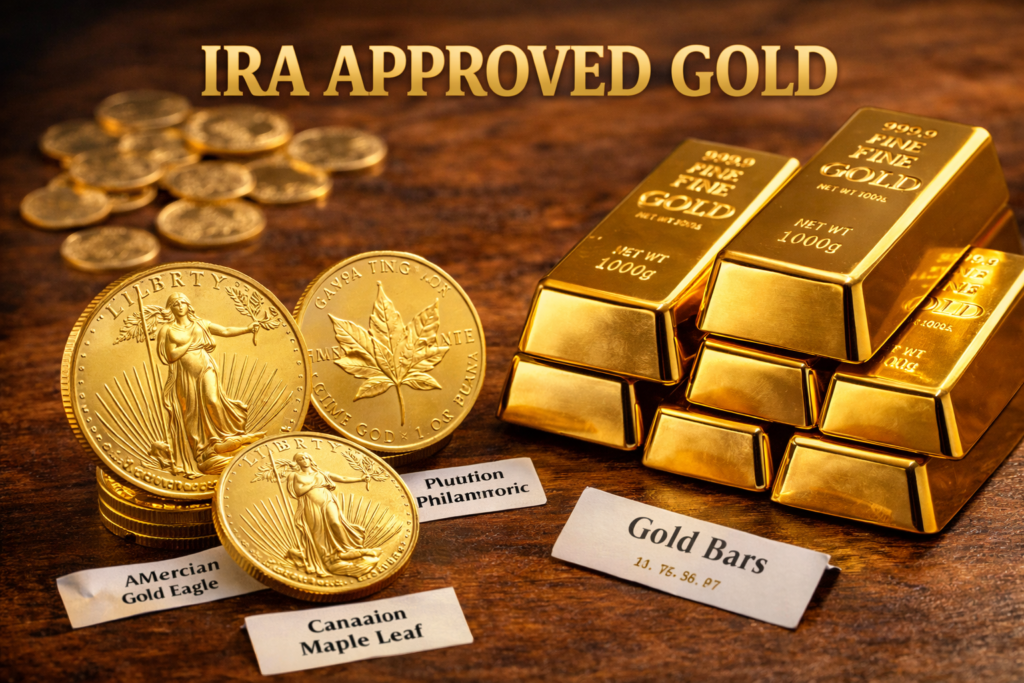
Many investors exploring precious metals retirement accounts eventually ask the same question: what gold is actually allowed inside a Gold IRA?
Not every gold coin or bar qualifies. The Internal Revenue Service (IRS) sets specific standards that determine whether a piece of bullion can legally be held in a self-directed retirement account.
Understanding which metals qualify as IRA approved gold is an essential step for anyone considering a gold IRA rollover or precious metals IRA investment.
In this guide we’ll explain:
- What IRA approved gold is
- The IRS purity requirements
- Which coins qualify for a gold IRA
- Which gold bars are eligible
- What metals are not allowed
- How gold is stored in an IRA
- How investors typically purchase approved metals
What Is IRA Approved Gold?
IRA approved gold refers to specific gold bullion coins and bars that meet IRS requirements for inclusion inside a self-directed Individual Retirement Account.
These requirements are defined under the Internal Revenue Code and generally focus on two main criteria:
- Minimum gold purity
- Approved coin or bullion status
Gold held in an IRA must typically be 99.5% pure (0.995 fineness) or higher. Certain widely recognized bullion coins are exceptions and may still qualify despite slightly lower purity levels due to their legal tender status and widespread recognition.
The purpose of these rules is to ensure retirement accounts hold investment-grade bullion, rather than collectible coins or numismatic items whose value depends heavily on rarity or collector demand.
Free Gold IRA Guide
Find the company path that fits your investment range
Answer two quick questions to see the Gold IRA company path matched to the amount you’re considering. No name, email, or phone number is required to view the result.
IRS Gold IRA Purity Requirements
One of the most important rules surrounding IRA approved gold is the purity standard.
In most cases, gold must meet the following minimum requirement:
Gold purity requirement:
99.5% pure (0.995 fineness)
This standard applies to most gold bars and bullion coins intended for retirement accounts.
Precious metals IRAs may also allow other metals with similar purity standards:
| Metal | Minimum Purity |
|---|---|
| Gold | 99.5% |
| Silver | 99.9% |
| Platinum | 99.95% |
| Palladium | 99.95% |
These metals must also come from approved refiners or government mints recognized in the bullion market.
Gold Coins Allowed in a Gold IRA
Several popular bullion coins qualify as IRA approved gold because they meet the required purity standards and are widely traded globally.
Below are some of the most commonly accepted coins in precious metals IRAs.
American Gold Eagle
The American Gold Eagle is one of the most well-known bullion coins in the world and is frequently included in precious metals IRAs.
Produced by the United States Mint, these coins carry legal tender status and strong recognition among investors.
Despite containing slightly less than 99.5% pure gold due to alloy content used for durability, the American Gold Eagle is specifically allowed under IRS rules.
American Gold Buffalo
The American Gold Buffalo coin contains 99.99% pure gold, making it one of the purest bullion coins produced by the U.S. Mint.
Because of its high purity level and official mint backing, it is commonly included in gold IRA accounts.
Canadian Gold Maple Leaf
The Canadian Maple Leaf coin is produced by the Royal Canadian Mint and is known for its exceptional purity.
With 99.99% gold content, it meets the IRS standard comfortably and is widely accepted for IRA holdings.
Australian Gold Kangaroo
The Australian Gold Kangaroo (sometimes called the Nugget series) is produced by the Perth Mint.
These coins contain 99.99% pure gold and are widely traded in the global bullion market.
Austrian Gold Philharmonic
Produced by the Austrian Mint, the Philharmonic coin contains 99.99% pure gold and is another commonly approved bullion option for retirement accounts.
For most people, a direct rollover is the preferred route.
Our #1 Recommendation for 2026! Call or Visit Now for Your Free Guide. A Florida Licensed and Bonded Precious Metals Company.
Read more in our feature article.

Gold Bars Allowed in a Gold IRA
In addition to coins, gold bars are often used in precious metals IRAs.
Bars must typically meet several criteria:
- Minimum purity of 99.5% gold
- Produced by an approved refiner or mint
- Properly stamped with weight and purity
- Stored in an approved depository
Common bar sizes include:
- 1 oz
- 10 oz
- 100 gram
- 1 kilogram
Large institutional bars (such as 400 oz London Good Delivery bars) are usually used by central banks or large institutions rather than retirement accounts.
Gold That Is NOT Allowed in an IRA
Many investors are surprised to learn that some popular coins do not qualify for retirement accounts.
In general, the IRS prohibits collectible coins from being held in IRAs.
Examples of items that typically do not qualify include:
- Rare or numismatic coins
- Pre-1933 gold coins
- Commemorative coins
- Jewelry or decorative gold items
- Collectible proof sets not recognized as bullion
The reason for this restriction is to prevent retirement accounts from holding assets whose value depends primarily on collector demand rather than metal content.
Precious metals IRAs are designed to hold investment bullion, not collectibles.

Why the IRS Restricts Certain Coins
The IRS restrictions are designed to keep retirement accounts focused on objective asset value rather than speculative collectibles.
Bullion coins and bars have pricing closely tied to:
- the global gold spot price
- weight and purity
- recognized mint production
Collectible coins, on the other hand, may derive value from factors such as:
- rarity
- historical significance
- collector demand
- condition grading
Because those factors can fluctuate dramatically, the IRS generally limits IRA holdings to standardized bullion products.
How Gold Is Stored in a Gold IRA
A gold IRA cannot typically store metals in an investor’s personal possession.
Instead, IRS rules require the use of an approved custodian and secure depository.
This means:
- The IRA account is administered by a qualified custodian.
- Metals are purchased through an authorized dealer.
- The bullion is shipped to a secure depository.
- The depository stores the metals on behalf of the retirement account.
Depositories used by precious metals IRAs often provide:
- high security vaults
- insurance coverage
- regular auditing
- segregated or non-segregated storage options
This structure ensures that retirement assets remain compliant with IRS regulations.
For most people, a direct rollover is the preferred route.
Our #1 Recommendation for 2026! Call or Visit Now for Your Free Guide. A Florida Licensed and Bonded Precious Metals Company.
Read more in our feature article.
How Investors Buy IRA Approved Gold
Most investors do not buy IRA approved gold independently and then attempt to place it into a retirement account.
Instead, the process usually follows these steps:
- Open a self-directed precious metals IRA
- Fund the account through a rollover or transfer
- Choose eligible bullion products
- Purchase metals through the IRA structure
- Store the metals in an approved depository
Many investors reach this stage after researching a gold IRA rollover, which allows retirement funds to move from traditional accounts into a precious metals IRA.
For a detailed explanation of that process, see our guide on gold IRA rollovers and retirement account transfers.
Why Many Investors Research IRA Approved Gold First
When investors begin exploring precious metals IRAs, they often start by researching the types of gold that can legally be held inside retirement accounts.
This step helps investors understand:
- what bullion products qualify
- how the IRS regulates metals
- what coins and bars are commonly used
- how precious metals are stored
Once those fundamentals are clear, investors can more easily evaluate custodians, depositories, and rollover options.
Comparing Precious Metals IRA Companies
Not all companies offering precious metals IRAs operate the same way.
When researching providers, investors often compare several factors:
- account setup assistance
- rollover support
- transparency of fees
- educational resources
- storage arrangements
- buyback policies
Understanding these differences can help investors make more informed decisions when considering a precious metals IRA.
IRA Approved Gold FAQ
What gold purity is required for a Gold IRA?
Gold must generally be 99.5% pure (0.995 fineness) to qualify for inclusion in a precious metals IRA, although certain coins like the American Gold Eagle are permitted exceptions.
Can I hold collectible gold coins in an IRA?
In most cases, collectible or numismatic coins are not allowed in a precious metals IRA. The IRS restricts retirement accounts to investment-grade bullion.
Are gold bars allowed in a Gold IRA?
Yes. Gold bars can be held in a precious metals IRA as long as they meet the minimum purity standard and come from approved refiners.
Can I store my IRA gold at home?
Gold held in an IRA must typically be stored in an approved depository under the supervision of the IRA custodian rather than kept at home.
Why do investors use gold in retirement accounts?
Some investors consider gold as a portfolio diversification tool because it behaves differently from traditional financial assets like stocks and bonds.
Final Thoughts
Understanding which metals qualify as IRA approved gold is one of the most important steps when researching precious metals retirement accounts.
Because the IRS restricts retirement holdings to specific bullion coins and bars, investors should carefully review eligibility rules before purchasing metals.
By focusing on investment-grade bullion that meets IRS standards, retirement investors can ensure their precious metals holdings remain compliant within a self-directed IRA structure.