
This site is reader supported and purchases made through the links may generate a commision.
Thanks for help supporting the site. Information only – not to be considered financial advice.
The global silver market is experiencing unprecedented structural changes that extend far beyond typical commodity cycles. A perfect storm of accelerating industrial demand, constrained mining output, and dwindling above-ground inventories has created what analysts increasingly describe as a silver supply crisis. This comprehensive analysis examines why silver—essential for everything from solar panels to artificial intelligence infrastructure—faces persistent supply deficits that could fundamentally alter its market dynamics by 2026.
What the Silver Supply Crisis Is
Silver inventories at major exchanges have declined significantly since 2020
The silver supply crisis represents a fundamental imbalance between global production capacity and accelerating demand that cannot be quickly resolved through normal market mechanisms. Unlike temporary shortages that typically self-correct through price adjustments, the current silver deficit appears structural and persistent, driven by converging factors that constrain supply while simultaneously boosting consumption.
At its core, this crisis stems from five consecutive years of supply deficits totaling approximately 800 million ounces since 2021—equivalent to nearly an entire year of global production. Current projections for 2025-2026 show continuing deficits ranging from 95 to 149 million ounces annually, with global mine production stagnating around 820-835 million ounces while total demand exceeds 1.2 billion ounces.
The visible evidence of this deficit appears in exchange inventories worldwide:
- COMEX registered silver inventories have declined over 70% from their 2020 peak
- London Metal Exchange stocks have reached historic lows
- Shanghai inventories have fallen to their lowest levels since 2016
- Silver lease rates (the cost to borrow physical silver) have spiked to 200% annualized during periods of acute scarcity
These inventory drawdowns represent a systematic depletion of above-ground stockpiles that have historically served as buffers during periods of market imbalance. As these buffers thin, price volatility increases and the physical market becomes increasingly vulnerable to supply disruptions.
How Above-Ground Silver Inventories Work
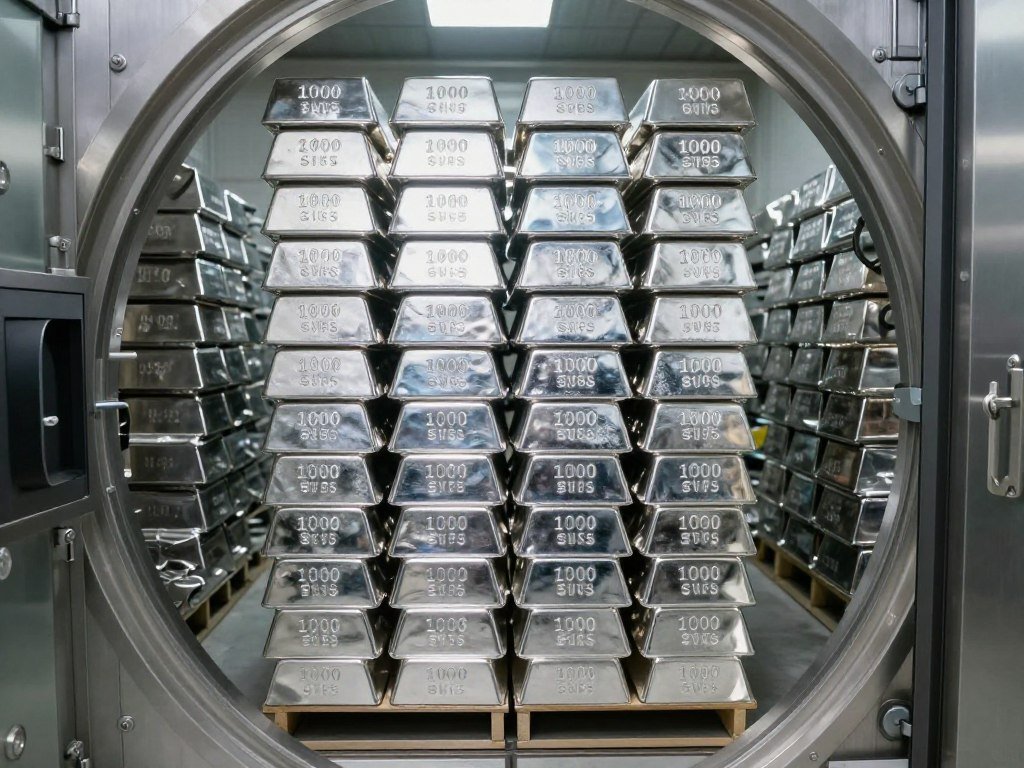
Above-ground silver inventories represent the accumulated stockpile of refined silver that exists outside of active mining operations. These inventories serve as crucial buffers in the global silver market, helping to balance short-term supply and demand fluctuations. Understanding how these inventories function is essential to comprehending the current supply crisis.
Categories of Above-Ground Silver
Above-ground silver exists in several distinct categories, each with different market accessibility and price sensitivity:
| Inventory Category | Description | Market Accessibility | Price Sensitivity |
| Exchange Inventories | Silver held in COMEX, LBMA, and other exchange-approved vaults | High – directly available for delivery against futures contracts | Medium – responds to short-term market conditions |
| ETF Holdings | Silver backing exchange-traded products | Medium – not directly accessible but impacts market through creation/redemption | High – fluctuates with investment sentiment |
| Industrial Stockpiles | Working inventories held by manufacturers | Low – not generally available to market | Low – maintained regardless of price fluctuations |
| Government/Strategic Reserves | National stockpiles and central bank holdings | Very Low – rarely enters market | Very Low – strategic rather than economic considerations |
| Private Investment Holdings | Coins, bars, and other forms held by individuals | Low to Medium – enters market gradually at higher prices | Medium – some selling at significantly higher prices |
Exchange Inventory Mechanics
Exchange inventories play a particularly crucial role in price discovery and market function. These inventories are typically categorized as either “registered” (available for delivery against futures contracts) or “eligible” (meeting exchange standards but not currently available for delivery).
The relationship between these inventory categories provides important signals about market tightness:
- Declining registered inventories indicate increasing physical demand and potential delivery stress
- Rising eligible-to-registered ratios often signal reluctance among holders to make metal available for delivery
- Backwardation in the futures curve (near-term contracts trading at premiums to longer-dated ones) suggests immediate physical scarcity
As of early 2026, COMEX registered silver inventories have fallen to approximately 82 million ounces—down from 346 million ounces in 2020. This 76% decline represents a significant reduction in immediately deliverable silver, increasing the risk of delivery defaults or cash settlements rather than physical delivery.
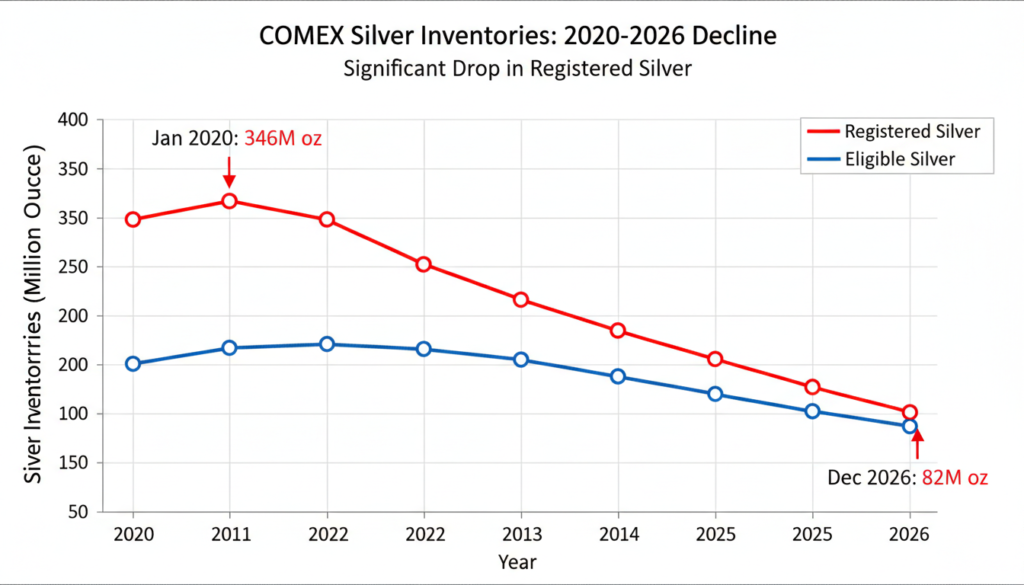
COMEX registered vs. eligible silver inventories (2020-2026)
Inventory Depletion Patterns
The systematic drawdown of above-ground inventories follows a predictable pattern during extended deficit periods:
- Exchange inventories deplete first, as they represent the most liquid and accessible silver
- ETF holdings typically follow, as investors may liquidate positions or ETF operators may struggle to source physical metal
- Industrial stockpiles begin to thin as manufacturers prioritize production continuity
- Private investment holdings enter the market gradually at higher price points
- Strategic reserves remain largely untouched except in extreme circumstances
The current depletion pattern has followed this sequence, with exchange inventories already severely reduced and ETF holdings showing periodic outflows during price spikes. This progressive thinning of market buffers increases the potential for price volatility and physical premiums over spot prices.
Why Most Silver Is Mined as a Byproduct
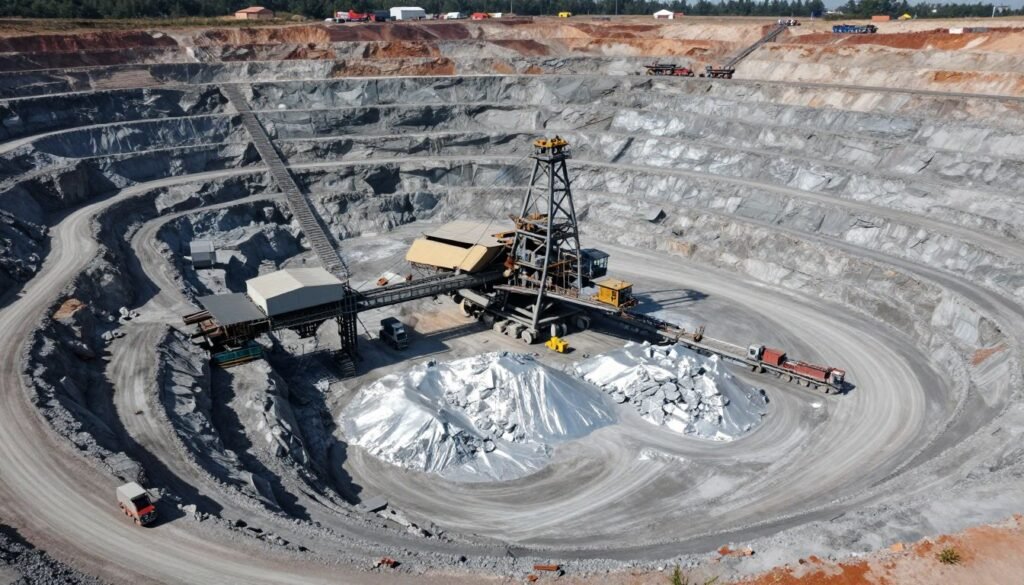
One of the most critical factors in the silver supply crisis is the metal’s production profile. Unlike gold, which is primarily extracted from dedicated gold mines, approximately 75-80% of global silver production emerges as a byproduct from operations primarily targeting other metals—particularly copper, zinc, lead, and gold.
The Byproduct Production Model
This byproduct dependency creates fundamental constraints on supply responsiveness. When silver is produced as a secondary metal, production decisions are based on the economics of the primary metal rather than silver prices. This creates a situation where:
- Higher silver prices alone cannot stimulate increased production if base metal economics remain unfavorable
- Silver output can actually decrease during silver bull markets if they coincide with base metal bear markets
- Production costs are allocated primarily to the main metal, making silver production appear artificially inexpensive
Primary Silver Mines (20-25% of Production)
- Production decisions based directly on silver economics
- Responsive to silver price signals
- Generally higher production costs when allocated solely to silver
- Often smaller operations with limited expansion capacity
Byproduct Silver Mines (75-80% of Production)
- Production decisions based on primary metal economics
- Limited responsiveness to silver price signals
- Lower apparent production costs due to cost allocation
- Often larger operations with significant output volumes
Geographic Distribution of Byproduct Production
The byproduct nature of silver production is reflected in its geographic distribution, with major silver-producing regions closely aligned with base metal mining centers:
| Country | Annual Production (Million oz) | Primary Production (%) | Byproduct Production (%) | Main Associated Metals |
| Mexico | 190 | 40% | 60% | Gold, Lead, Zinc |
| Peru | 115 | 15% | 85% | Copper, Zinc, Lead |
| China | 120 | 5% | 95% | Lead, Zinc, Copper |
| Russia | 60 | 10% | 90% | Copper, Nickel, Gold |
| Australia | 45 | 5% | 95% | Lead, Zinc, Copper |
This production distribution creates regional supply vulnerabilities. For example, China’s recent export restrictions on various metals, including silver, directly impact global supply chains by potentially removing a significant portion of refined silver from international markets.
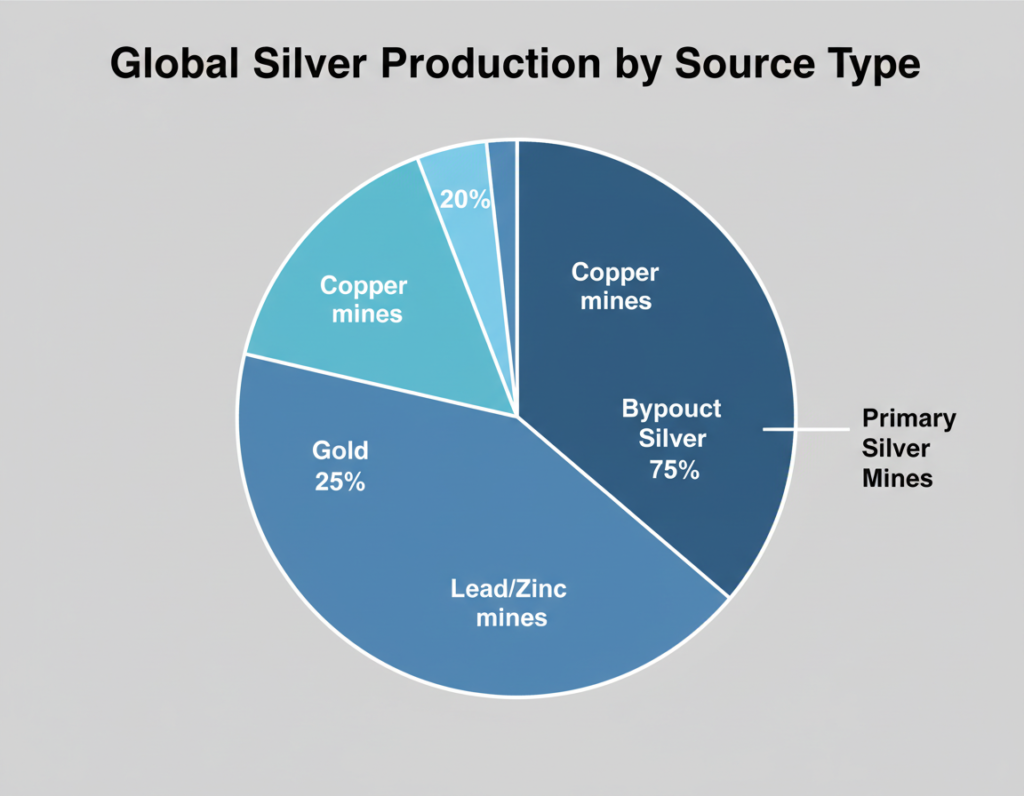
Global silver production by source type (2025 data)
Why Higher Prices Do Not Quickly Increase Supply
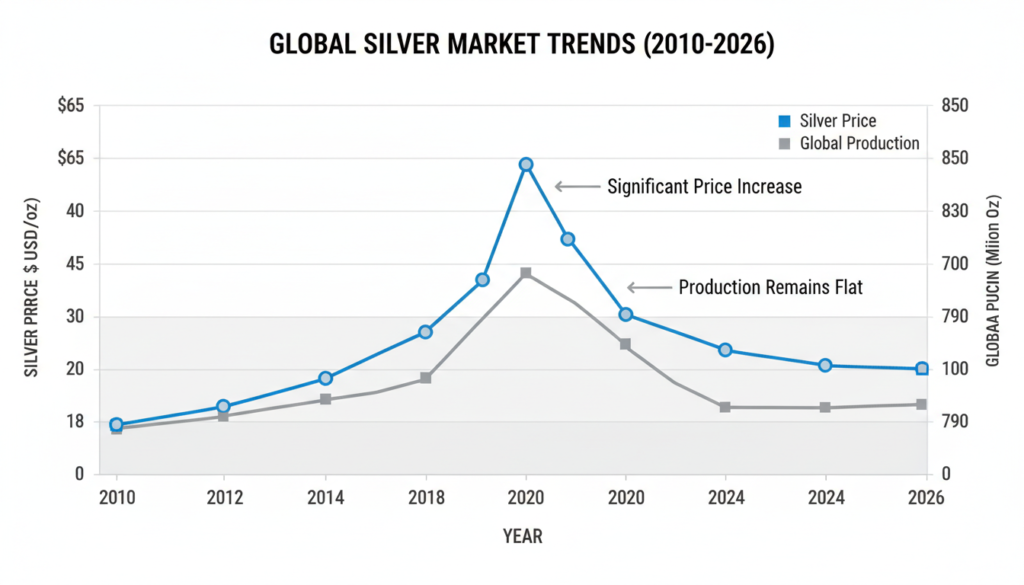
In conventional commodity markets, price increases typically stimulate production growth as producers respond to profit incentives. However, the silver market exhibits unusual supply inelasticity—a condition where production fails to expand significantly despite substantial price increases. This phenomenon is central to understanding the persistent nature of the current silver supply crisis.
Byproduct Economics Constraints
As previously discussed, silver’s status as a byproduct creates fundamental constraints on supply responsiveness. When 75-80% of production comes from mines primarily targeting other metals, silver price signals are muted in production decisions. A mine producing copper with silver as a byproduct will not increase production based on silver prices alone if copper economics don’t justify expansion.
Long Development Timelines
Even when economic incentives align, bringing new silver production online involves lengthy timelines:
- Exploration to discovery: 2-5 years
- Resource definition and economic studies: 2-3 years
- Permitting and regulatory approval: 2-5 years (jurisdiction dependent)
- Construction and development: 2-3 years
- Ramp-up to full production: 1-2 years
This 7-15 year timeline from initial exploration to full production means that today’s price signals influence production capacity nearly a decade later. The silver bear market from 2011-2020 resulted in minimal exploration investment, creating a project pipeline gap that higher prices since 2021 cannot quickly address.
Grade Decline in Existing Operations
Existing silver mines face natural production constraints through grade decline—the tendency of ore quality to decrease as the highest-grade portions of deposits are mined first. Analysis of major silver producers shows average ore grade declines of 1.5-3% annually, requiring either:
- Processing more ore to maintain production levels (increasing costs)
- Accepting gradual production declines despite steady operations
- Investing in exploration to discover new high-grade zones (uncertain outcomes)
This natural depletion creates a production headwind that new projects must overcome just to maintain global output levels, let alone increase them.
Capital Intensity and Investment Cycles
Silver mining is highly capital-intensive, with new primary silver mines typically requiring $100-200 million in development capital per 1 million ounces of annual production capacity. This capital intensity creates several constraints:
The combination of byproduct dependency, development timelines, grade declines, and capital constraints creates a situation where silver supply remains relatively inelastic to price changes over timeframes of 5-7 years or less. This supply inelasticity is a fundamental driver of the current crisis and suggests that even sustained higher prices cannot quickly resolve the structural deficit.
The practical result is that silver production has remained essentially flat since 2016 despite significant price increases in recent years. Global mine production was approximately 820 million ounces in 2016 and is projected at 835 million ounces for 2026—a mere 1.8% increase over a decade during which silver prices more than doubled.
Industrial Demand from AI, Solar, Defense, and Electronics

While supply constraints form one side of the silver crisis equation, accelerating industrial demand creates equally powerful pressure from the consumption side. Silver’s unique physical and chemical properties—including the highest electrical conductivity, thermal conductivity, and reflectivity of any element—make it irreplaceable in many high-technology applications.
Solar Energy: The Silver-Intensive Green Transition
Photovoltaic (PV) solar technology represents one of the largest and fastest-growing sources of silver demand. Standard silicon solar cells use silver paste for front-side metallization, creating the conductive grid that collects and transmits electricity.
- A typical solar panel contains approximately 15-20 grams of silver
- Global solar installations exceeded 260 GW in 2023 and continue growing
- Total PV silver consumption reached approximately 140-160 million ounces annually
- Silver represents 10-15% of the material cost in standard silicon PV cells
While manufacturers continuously work to reduce silver content through thrifting (using less silver per cell) and pursue alternative materials, these efforts face diminishing returns. Silver loading has already decreased from 400 mg per cell in 2010 to around 20 mg in 2025, but further reductions compromise efficiency and durability.
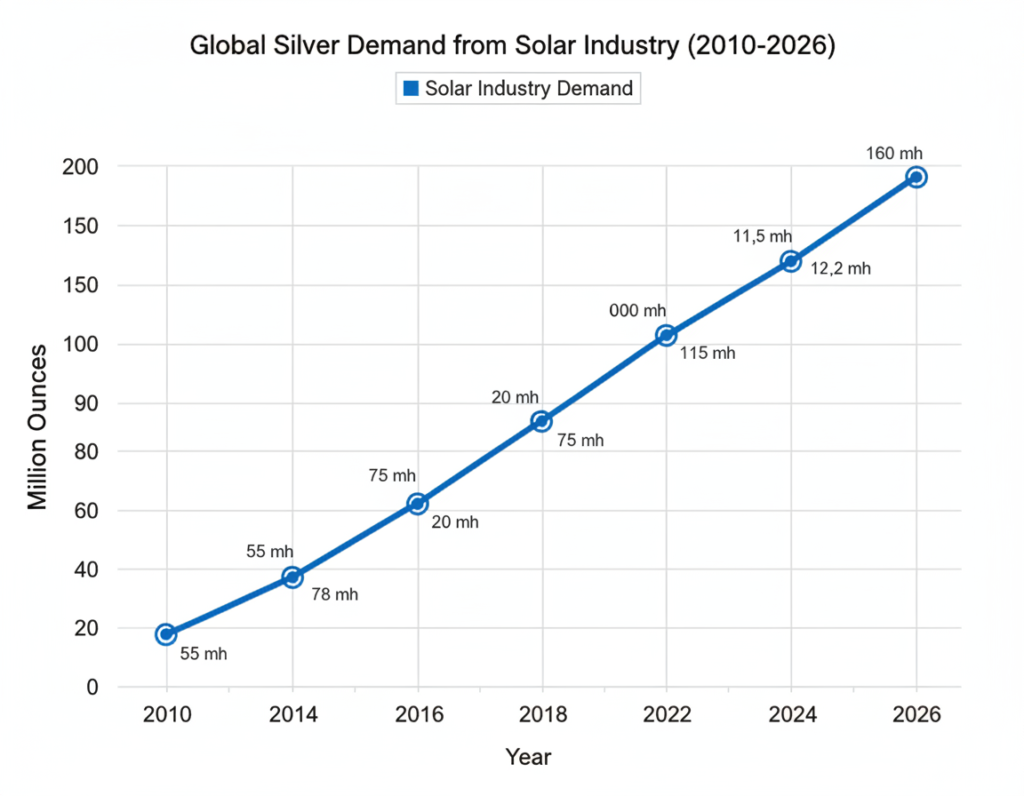
Solar industry silver demand has grown steadily despite thrifting efforts
Artificial Intelligence Infrastructure
The artificial intelligence revolution has created a new source of silver demand that few market forecasts fully incorporated until recently. AI systems require massive data centers with specialized hardware that contains significant silver content:
- Advanced semiconductors use silver in die attach materials and interconnects
- High-performance computing systems require silver-based thermal interface materials
- Power distribution systems utilize silver in contacts and switches
- Data center cooling systems incorporate silver for antimicrobial properties
Additionally, the nuclear power renaissance driven partly by AI energy demands creates another silver consumption vector. Nuclear reactor control rods often use silver-indium-cadmium alloys (typically 80% silver) for neutron absorption. A standard large reactor contains approximately 1.74 tonnes (56,000 ounces) of silver in its control systems.
Electronics and Consumer Devices
Traditional electronics continue to represent a major silver consumption category, with applications including:
Consumer Electronics
- Smartphones (250-300 mg per device)
- Tablets and laptops (1-3 grams per device)
- LED displays and lighting
- Wearable technology
Industrial Electronics
- RFID tags and sensors
- Medical devices and equipment
- Automotive electronics and control systems
- Aerospace and defense systems
Total electronics-related silver demand exceeds 240-260 million ounces annually, with growth driven by both increasing device volumes and the expansion of electronics into previously non-electronic products (the “Internet of Things” phenomenon).
Defense and Strategic Applications
Silver’s critical role in defense technologies has elevated its strategic importance, leading the U.S. government to classify it as a critical mineral in 2025. Defense applications include:
- Missile guidance systems and avionics
- Radar and electronic warfare equipment
- Satellite communications systems
- Submarine batteries and electrical systems
This strategic designation reflects recognition that silver dependency extends beyond discretionary consumption into essential infrastructure and national security considerations, potentially leading to strategic stockpiling that further tightens available supply.
The combination of green energy transition, AI infrastructure expansion, continued electronics growth, and strategic applications has created industrial silver demand exceeding 700 million ounces annually—approaching 85% of global mine production. This demand appears structural rather than cyclical, as it is driven by technological transformation and strategic imperatives rather than economic cycles alone.
Investment Demand vs Industrial Demand
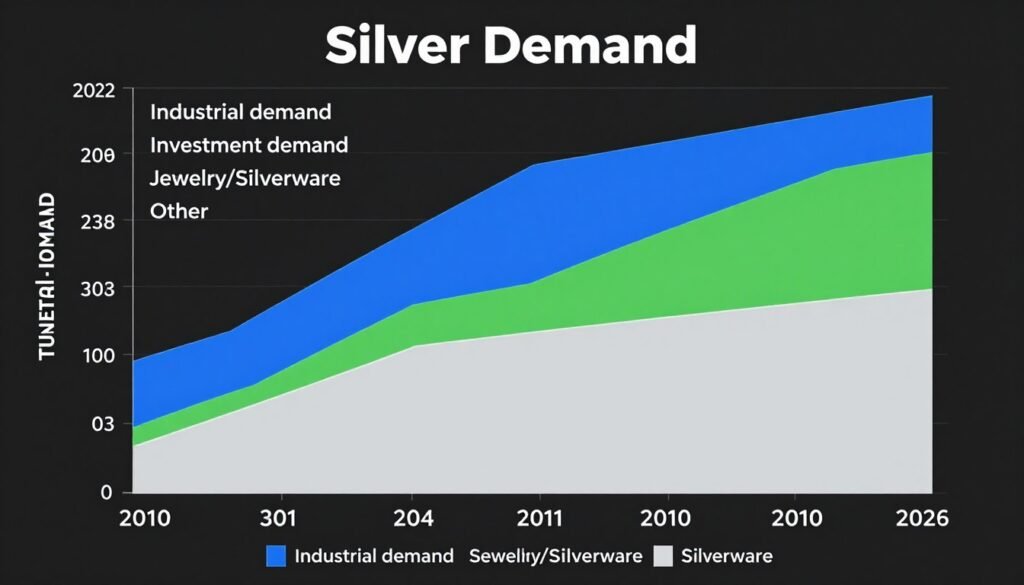
The silver market’s unique position as both an industrial commodity and a monetary metal creates a dynamic tension between two fundamentally different demand drivers. Understanding this dual nature is essential to comprehending the current supply crisis and its potential trajectory.
Demand Profile Comparison
Industrial and investment demand exhibit markedly different characteristics:
| Characteristic | Industrial Demand | Investment Demand |
| Price Sensitivity | Low to Medium – Many applications have limited substitution options | High – Responds quickly to price movements and market sentiment |
| Consumption Pattern | Continuous and relatively predictable | Episodic and potentially volatile |
| Recycling Potential | Limited – Much industrial silver is used in tiny amounts difficult to recover | High – Investment silver remains in concentrated, recoverable form |
| Growth Drivers | Technological development and industrial production | Monetary policy, inflation expectations, financial uncertainty |
| Demand Reversibility | Low – Once used in products, not readily returned to market | Medium to High – Can return to market when prices rise |
Current Demand Balance
The silver market’s demand profile has evolved significantly over the past decade, with industrial applications claiming an increasing share of total consumption:
- Industrial demand: 700-750 million ounces (approximately 60% of total)
- Investment demand: 300-400 million ounces (approximately 25-30% of total)
- Jewelry and silverware: 150-200 million ounces (approximately 15% of total)
This shift toward industrial dominance represents a fundamental change from historical patterns where investment and decorative uses claimed larger shares of demand. The increasing industrial proportion creates more inelastic overall demand, as industrial consumption tends to be less price-sensitive than investment.
Investment Demand Dynamics
Investment demand for silver manifests through several channels:
Physical Investment
- Retail coins and small bars
- Institutional bars (1000 oz)
- Private vaulting services
Paper Investment
- Exchange-traded products (ETFs)
- Futures and options
- Mining company shares
Investment demand exhibits much higher volatility than industrial consumption, creating boom-bust cycles that can temporarily mask or exacerbate underlying structural trends. For example, ETF outflows during 2022 partially offset physical market tightness, while strong ETF inflows in 2025 amplified it.
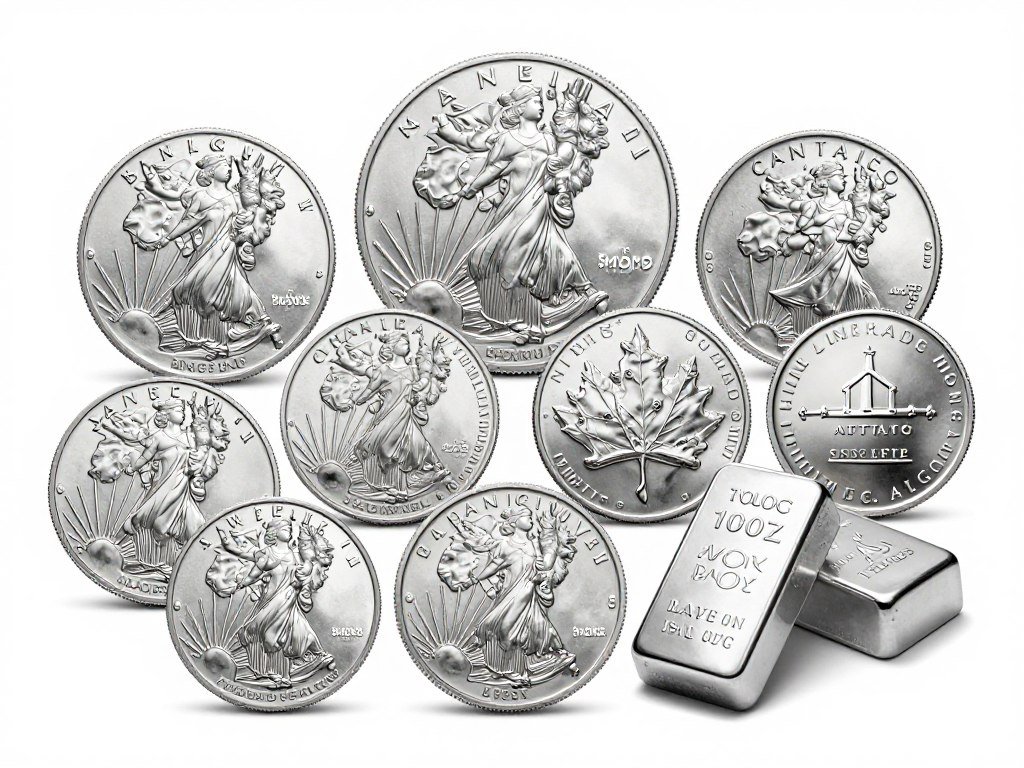
Physical silver investment products remain popular despite price increases
Central Bank and Strategic Demand
A new factor emerging in the silver market is central bank and strategic government purchasing. Historically, central banks focused almost exclusively on gold rather than silver for reserves. However, recent developments suggest this may be changing:
- Russia has reportedly begun adding silver to strategic reserves
- India has accumulated substantial silver through government and corporate channels
- China’s designation of silver as a strategic material suggests potential stockpiling
While difficult to quantify precisely, analysts estimate this strategic demand could account for 100-200 million ounces annually—a significant new source of consumption that competes directly with industrial users for available supply.
The current silver supply crisis reflects a perfect storm where industrial demand has reached record levels while investment demand remains robust and new strategic purchasing emerges. Unlike previous silver bull markets driven primarily by investment speculation, the present situation features strong fundamental demand across multiple sectors, creating more persistent pressure on limited supplies.
Comparison Between Silver and Gold Supply Dynamics
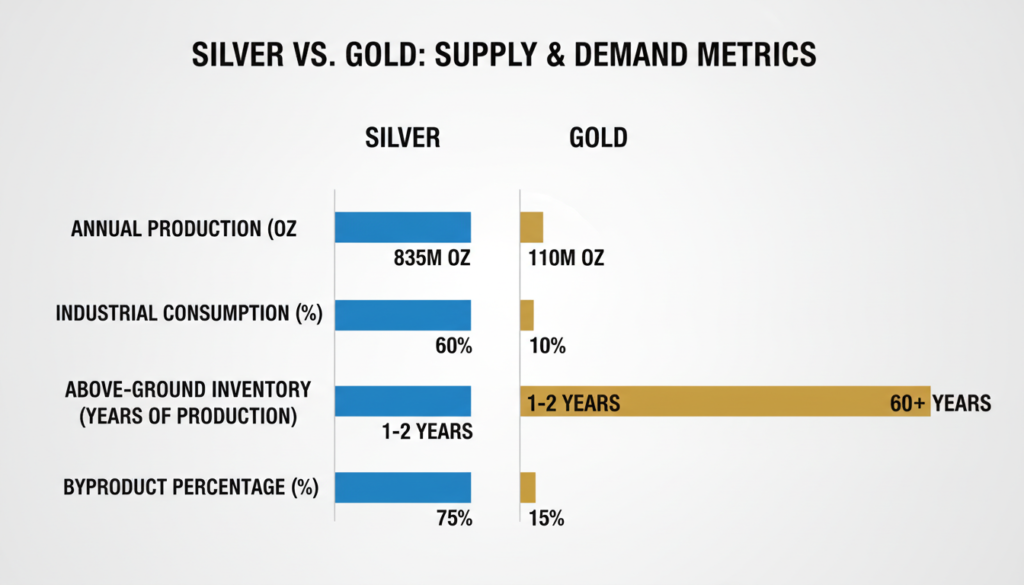
While silver and gold are often grouped together as “precious metals,” their supply dynamics differ dramatically. These differences help explain why silver faces more acute supply constraints and why its price behavior can diverge significantly from gold.
Production Profiles
The most fundamental difference between silver and gold lies in their production profiles:
| Supply Characteristic | Silver | Gold |
| Annual Production (2025) | 835 million ounces | 110 million ounces |
| Primary vs. Byproduct | 25% primary, 75% byproduct | 85% primary, 15% byproduct |
| Production Concentration | Top 5 countries: 65% of production | Top 5 countries: 40% of production |
| Production Growth (2016-2026) | 1.8% total (0.18% annually) | 12% total (1.1% annually) |
| Recycling Contribution | 20% of annual supply | 25-30% of annual supply |
Gold’s predominantly primary production profile means its supply responds more directly to gold prices, while silver’s byproduct status creates the supply inelasticity discussed earlier.
Above-Ground Inventory Differences
Perhaps the most striking difference between silver and gold lies in their above-ground inventory profiles:
- Gold: Approximately 6-7 billion ounces (60+ years of current production)
- Silver: Approximately 1-2 billion ounces (1-2 years of current production)
This dramatic difference results from silver’s industrial consumption pattern. While approximately 90-95% of all gold ever mined remains in existence as above-ground inventory (in bullion, jewelry, or other forms), only about 10-15% of all silver ever produced remains available. The rest has been industrially consumed in ways that make recovery economically unfeasible.
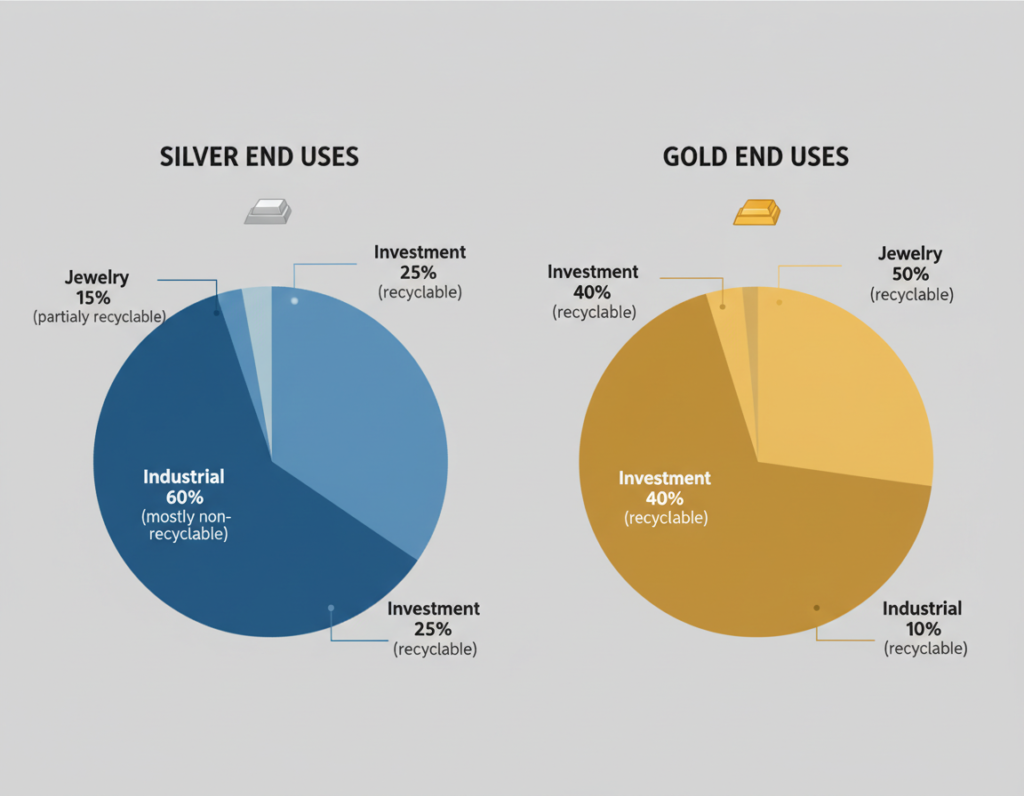
End uses of silver vs. gold and their recyclability profiles
Demand Profile Differences
The demand profiles of silver and gold differ substantially:
Silver Demand
- Industrial: 60% (growing)
- Investment: 25-30% (fluctuating)
- Jewelry/Decorative: 15% (stable)
Gold Demand
- Jewelry: 45-50% (stable)
- Investment: 35-40% (fluctuating)
- Central Banks: 10-15% (growing)
- Industrial: 5-10% (stable)
Gold’s demand profile is dominated by store-of-value applications (jewelry and investment), which can return to the market when prices rise. Silver’s growing industrial consumption creates permanent removal from above-ground stocks.
Market Size and Liquidity
The gold market dwarfs silver in terms of total value and daily trading volume:
- Gold market value: Approximately $12-15 trillion (all above-ground gold)
- Silver market value: Approximately $50-60 billion (all above-ground silver)
- Daily gold trading: $150-200 billion
- Daily silver trading: $10-15 billion
This size disparity means silver can experience more pronounced price movements from similar capital flows. A $1 billion investment allocation to precious metals might barely move gold prices while creating significant impact in the smaller silver market.
The fundamental differences between silver and gold supply dynamics—particularly silver’s byproduct dependency, smaller above-ground inventory, and industrial consumption pattern—create the conditions for more acute supply constraints in silver. While gold faces its own supply challenges, the structural factors in the silver market are more immediate and potentially more difficult to resolve through normal market mechanisms.
Historical Examples of Silver Shortages
While the current silver supply crisis has unique structural characteristics, examining historical episodes of silver shortages provides valuable context for understanding market behavior during periods of physical tightness.
The Hunt Brothers Episode (1979-1980)
Perhaps the most infamous silver shortage occurred in 1979-1980 when Nelson Bunker Hunt and William Herbert Hunt attempted to corner the silver market:
- The Hunts accumulated an estimated 100 million ounces of physical silver
- Silver prices rose from $6 to $50 per ounce in just over a year
- COMEX changed trading rules to break the corner, limiting positions
- Prices collapsed when the Hunts could not meet margin calls
While often dismissed as merely a manipulation episode, the Hunt corner worked partly because it exploited existing physical tightness. The late 1970s featured high inflation, monetary uncertainty, and industrial demand growth—creating conditions where a large buyer could accelerate a supply squeeze already developing.
The 2011 Post-Financial Crisis Peak
Following the 2008 financial crisis, silver experienced another significant shortage period:
- Prices rose from under $10 in 2008 to nearly $50 by April 2011
- Physical premiums expanded dramatically, particularly for retail products
- Delivery delays became common for both retail and wholesale silver
- ETF holdings increased dramatically, removing metal from available supply
This episode reflected both investment demand driven by quantitative easing and industrial recovery following the global recession. The combined pressure created physical tightness that manifested in delivery delays and premium expansion before prices ultimately retreated.
The COVID-19 Supply Chain Disruption (2020)
A more recent, though shorter-lived, silver shortage occurred during the early COVID-19 pandemic:
- Refinery and mint closures created acute physical product shortages
- Retail premiums expanded to 50-100% over spot prices
- COMEX futures briefly traded at significant discounts to physical prices
- Logistics disruptions prevented normal arbitrage from resolving price disparities
This episode demonstrated how quickly physical silver markets can tighten when supply chains are disrupted, even without dramatic spot price movements. The disconnect between paper and physical markets became particularly evident during this period.
Common Patterns in Silver Shortages
Examining these historical episodes reveals several consistent patterns that may be relevant to the current situation:
- Physical premiums expand before spot prices fully reflect shortages
- Delivery delays emerge as early warning signals of tightness
- Market rule changes often occur when established systems come under stress
- Price movements can be dramatically larger than fundamental factors might suggest
- Resolution typically involves some combination of demand destruction, supply response, and substitution—though each takes time to develop
The key difference between historical episodes and the current situation lies in the structural nature of today’s deficit. Previous shortages were largely driven by investment demand spikes or temporary supply disruptions. The current crisis involves persistent industrial demand growth against structurally constrained supply—potentially creating more sustained tightness than historical precedents.
Why Silver Is More Volatile Than Gold
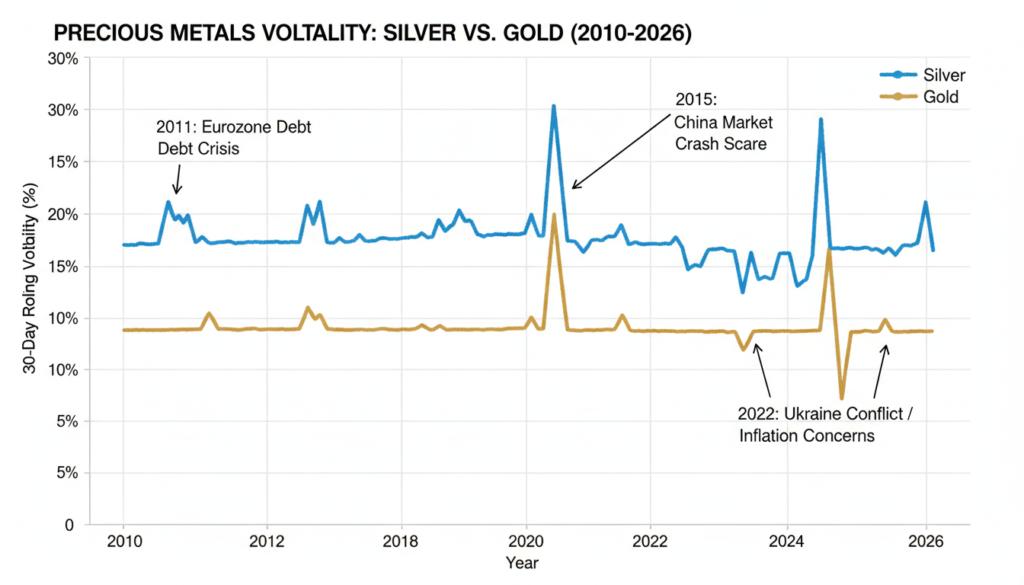
Silver’s price behavior is notoriously more volatile than gold, earning it the nickname “the restless metal” among traders. This enhanced volatility is not random but stems from specific structural characteristics of the silver market that become particularly pronounced during supply constraint periods.
Market Size and Depth
The most fundamental driver of silver’s higher volatility is its much smaller market size:
- The total value of all above-ground silver is approximately $50-60 billion
- The total value of all above-ground gold exceeds $12-15 trillion
This 200-250x size difference means equivalent capital flows create much larger price impacts in silver. For example, a $5 billion investment allocation shift might move gold prices by less than 1% while potentially moving silver by 10-15%.
The Dual Monetary/Industrial Nature
Silver’s unique position as both monetary metal and industrial commodity creates volatility through competing demand drivers:
- As a monetary metal, silver responds to inflation expectations, currency movements, and financial uncertainty
- As an industrial metal, silver responds to economic growth, manufacturing activity, and sector-specific developments
These dual influences can reinforce each other during certain economic conditions (creating sharp rallies) or conflict during others (creating heightened volatility). Gold, with its predominantly monetary role, typically responds to a narrower set of influences.
Lower Liquidity and Higher Leverage
The silver market’s structure contributes to volatility through several mechanisms:
Liquidity Factors
- Thinner order books in futures markets
- Wider bid-ask spreads in physical markets
- Fewer market makers providing liquidity
- Concentrated ownership in key ETFs
Leverage Factors
- Higher futures margin leverage than gold
- Greater paper-to-physical ratios
- More pronounced short positioning
- Higher retail speculation component
These structural characteristics create conditions where price movements can accelerate quickly once key technical levels are breached, leading to cascading effects through stop-loss triggering and margin calls.
Quantifying Silver’s Volatility Premium
Historical data provides clear evidence of silver’s volatility premium over gold:
| Volatility Metric | Silver | Gold | Silver Premium |
| Average Annual Volatility (2000-2025) | 30-35% | 15-20% | ~2x |
| Largest Single-Day Move (2000-2025) | 18.4% | 8.6% | ~2.1x |
| Largest 30-Day Move (2000-2025) | 47.2% | 23.5% | ~2x |
| Average Daily Range (% of price) | 2.5-3.5% | 1.2-1.8% | ~2.1x |
This volatility premium has important implications for investors and industrial users. For investors, it means silver positions typically require wider stop-loss parameters and greater tolerance for interim drawdowns. For industrial users, it creates more complex hedging challenges and inventory management considerations.
During periods of supply constraint like the current crisis, silver’s inherent volatility can become even more pronounced. The combination of structural market tightness and silver’s naturally higher volatility creates conditions where price movements may exceed what fundamental analysis alone might suggest is reasonable. This “volatility premium” should be factored into both investment and industrial planning around silver.
What Supply Constraints Mean for Future Pricing
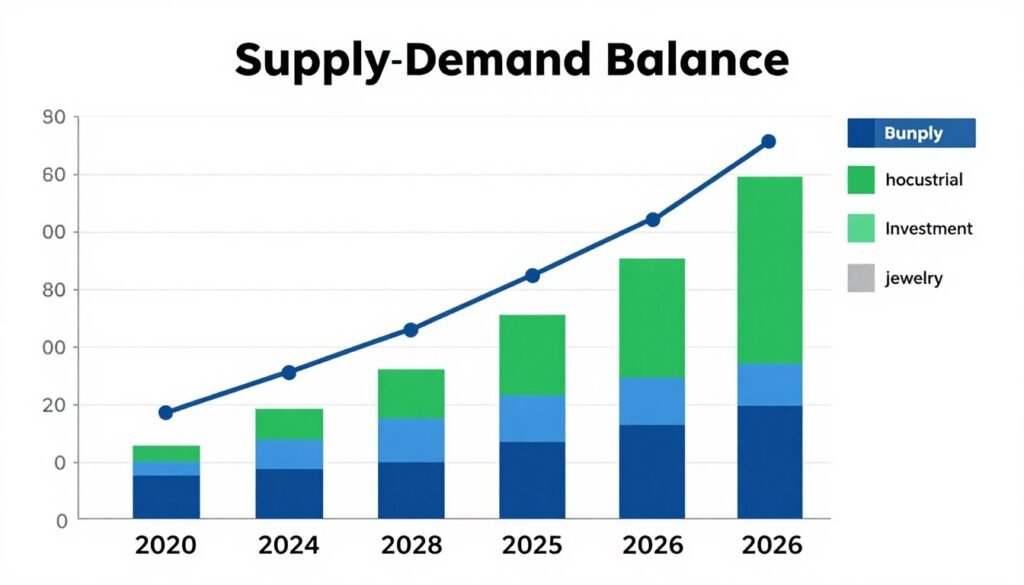
While specific price predictions are beyond the scope of this analysis, understanding the mechanisms through which supply constraints influence market pricing provides valuable context for interpreting silver market developments. The persistent structural deficit in silver creates several distinct pricing pressures worth examining.
Physical Premium Expansion
One of the most direct manifestations of physical silver scarcity is the expansion of premiums over spot prices. These premiums appear at multiple market levels:
- Retail product premiums (coins, small bars) have expanded from historical 8-10% to 30-50% in some markets
- Wholesale premiums for 1000 oz bars have increased from typical $0.50-$1.00 to $3.00-$5.00 per ounce
- Regional premiums have developed, with Shanghai silver trading $6-9 over COMEX futures
These premium expansions effectively create a two-tier pricing system where paper silver (futures, unallocated accounts) trades at a discount to physical metal. This divergence typically precedes adjustments in the underlying spot price as physical constraints eventually force paper markets to recalibrate.
Futures Curve Backwardation
Under normal conditions, futures markets display contango—a structure where longer-dated contracts trade at premiums to near-term ones, reflecting storage and financing costs. During physical shortages, this relationship can invert into backwardation, where immediate delivery commands a premium over future delivery.
Silver’s futures curve has entered its deepest backwardation since 1980, with front-month contracts trading several dollars above later contracts. This pricing structure indicates intense demand for immediate physical delivery and typically precedes significant spot price adjustments.
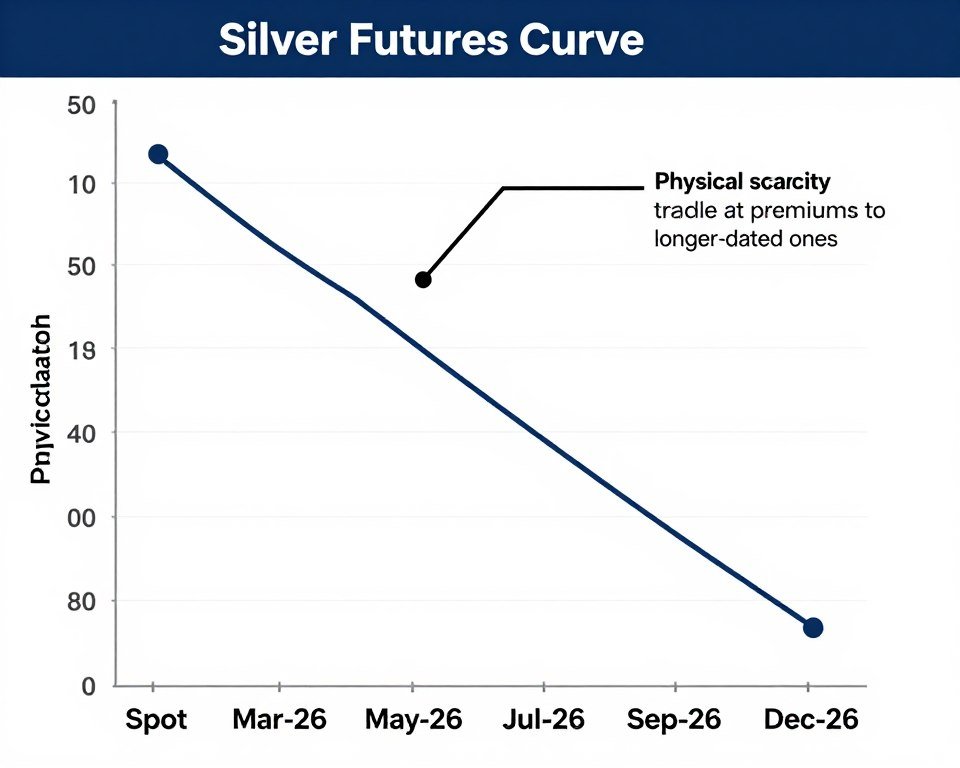
Silver futures curve showing backwardation – a key indicator of physical scarcity
Lease Rate Elevation
Silver lease rates—the cost to borrow physical silver—provide another window into market tightness. These rates have spiked to 50-200% annualized during recent acute scarcity periods, compared to normal levels of 0.1-0.5%.
Elevated lease rates directly impact market dynamics by:
- Increasing the cost of short positions that require borrowed metal
- Raising carrying costs for industrial users maintaining inventories
- Creating profitable opportunities for holders of physical silver to lease out metal
- Potentially forcing short covering when borrowing costs exceed potential gains
Market Structure Adaptation
Persistent supply constraints typically force adaptations in market structure and participant behavior:
Exchange Adaptations
- Increased margin requirements
- Position limit adjustments
- Delivery rule modifications
- Alternative settlement mechanisms
Participant Adaptations
- Industrial users increasing inventory buffers
- Miners renegotiating streaming agreements
- Refiners adjusting premium structures
- Investors shifting from paper to physical
These adaptations typically occur progressively as tightness persists, with each adjustment creating ripple effects through the broader market ecosystem.
Price Discovery Shift
Perhaps the most significant long-term impact of persistent supply constraints is the potential shift in price discovery mechanisms. Traditionally, COMEX futures and London OTC markets have dominated silver price discovery. However, as physical constraints intensify:
- Regional physical markets (Shanghai, Singapore) gain price discovery influence
- Direct dealer-to-client physical transactions become more price-relevant
- Paper-to-physical ratios compress as leveraged trading becomes more constrained
- Premium structures become more important in determining true transaction prices
The combination of physical premium expansion, futures curve backwardation, elevated lease rates, market structure adaptations, and price discovery shifts creates a complex pricing environment that cannot be reduced to simple supply-demand equations. While these mechanisms typically support higher prices during persistent deficits, the path is rarely linear and can involve significant volatility. Market participants should focus on physical market indicators rather than paper prices alone to gauge the true state of the silver market.
Physical Silver vs Paper Silver (ETFs, Futures)

The distinction between physical silver and paper silver claims has become increasingly important in the context of the current supply crisis. Understanding the different forms of silver exposure, their characteristics, and potential risks provides essential context for both investors and industrial users navigating this market.
- Physical gold & silver basics
- Common risks and misconceptions
- Steps to explore precious metals options
Forms of Silver Exposure
Silver exposure broadly falls into two categories—physical ownership and paper claims—each with multiple variations:
- Retail coins and small bars (direct possession)
- Allocated storage (specific bars assigned to owner)
- Segregated storage (physically separated holdings)
- Pool allocated (specific share of identified inventory)
- Private vaulting services (outside banking system)
Physical Silver
- Futures contracts (standardized exchange-traded)
- Options contracts (derivatives of futures)
- Exchange-traded funds (shares in pooled holdings)
- Unallocated accounts (general claim on bank metal)
- Mining shares (equity exposure to producers)
Paper Silver
Counterparty Risk Comparison
One of the most significant differences between physical and paper silver is counterparty risk—the risk that the entity promising to deliver silver will fail to do so:
| Silver Form | Counterparty Dependencies | Risk Level | Risk Mitigation Factors |
| Direct Physical Possession | None after purchase | Very Low | Physical security, insurance |
| Allocated Storage | Storage provider | Low | Audit rights, insurance, regulatory oversight |
| ETFs | Fund operator, custodian, sub-custodians | Medium | Audits, regulatory requirements, public reporting |
| Futures Contracts | Exchange, clearinghouse, potentially multiple counterparties | Medium-High | Margin requirements, clearinghouse guarantees |
| Unallocated Accounts | Bank/dealer, potentially multiple layers of claims | High | Limited – general creditor status |
During periods of acute physical scarcity, counterparty risk becomes increasingly relevant as the ability to source physical metal for delivery against paper claims may be compromised.
The Leverage Question
Paper silver markets operate with significant leverage—the ratio between paper claims and physical backing. While precise figures are difficult to determine, analysis suggests:
- COMEX open interest often represents 250-350x the registered inventory available for delivery
- London OTC market trades approximately 100-200x the physical silver actually stored in LBMA vaults
- Some unallocated accounts operate with 10-20x leverage (one ounce of physical backing 10-20 ounces of client claims)
This leverage functions smoothly during normal market conditions but can create systemic stress during physical shortages when delivery demands increase. The current supply crisis has already compressed some of these ratios as physical metal becomes harder to source.
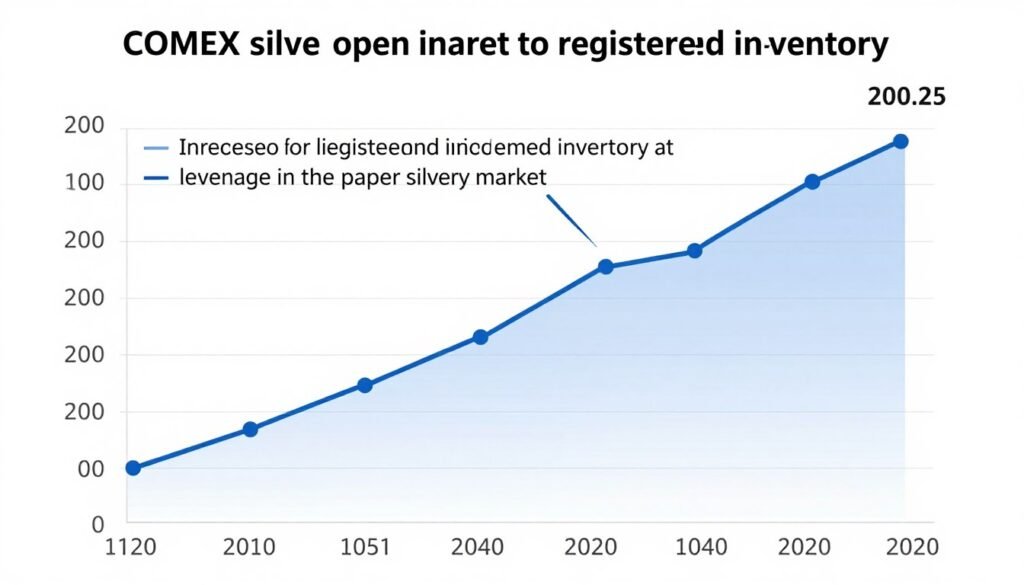
COMEX silver open interest to registered inventory ratio (2010-2026)
Premium Structures and Divergence
During supply constraints, physical and paper silver prices typically diverge, creating premium structures that reflect the scarcity of actual metal:
Retail Premium Examples (2026)
- Silver Eagles: 45-55% over spot
- Canadian Maple Leafs: 35-45% over spot
- Generic 1oz rounds: 25-35% over spot
- 100oz bars: 15-25% over spot
Wholesale Premium Examples (2026)
- 1000oz COMEX bars: $3-5 over spot
- Shanghai physical: $6-9 over COMEX
- Lease rates: 5-8% annualized
- Futures backwardation: $2-4 front-to-back
These premium structures effectively create a two-tier pricing system where paper silver trades at a discount to physical metal. This divergence typically precedes adjustments in the underlying spot price as physical constraints eventually force paper markets to recalibrate.
Conversion Challenges
The theoretical ability to convert paper claims to physical silver becomes increasingly challenged during supply constraints:
- ETF redemption mechanisms may face delays or limitations
- Futures contracts may settle in cash rather than physical delivery
- Unallocated accounts may invoke force majeure clauses or settlement alternatives
- Exchange position limits and delivery rules may change during market stress
These conversion challenges highlight the fundamental difference between owning physical silver and holding a claim that may theoretically be converted to physical under certain conditions.
The distinction between physical silver and paper claims becomes most critical during periods of supply constraint like the current crisis. While paper forms offer convenience, liquidity, and lower carrying costs during normal market conditions, they introduce counterparty and conversion risks that become increasingly relevant as physical scarcity intensifies. Market participants seeking genuine insulation from silver supply risks should carefully evaluate the specific characteristics and limitations of their chosen exposure method.
Frequently Asked Questions
Why doesn’t recycling solve the silver supply crisis?
Recycling currently contributes approximately 180-190 million ounces annually to silver supply (about 20% of total), but faces several constraints that limit its ability to resolve the deficit:
- Most industrial silver is used in tiny amounts per device (milligrams to grams), making recovery economically challenging
- Many applications result in permanent loss (photographic chemicals, medical uses, some electronics)
- Collection infrastructure remains limited in many regions
- Energy costs for recycling have increased, raising economic thresholds
While higher silver prices improve recycling economics, the distributed nature of silver in consumer products creates practical limits on recovery rates. Even optimistic projections suggest recycling could only increase to 250-300 million ounces annually by 2030—insufficient to close the current deficit.
Could new mining technologies increase silver production?
Mining technology advancements—including automation, AI-optimized processing, and improved recovery methods—offer incremental rather than transformative production increases. Key limitations include:
- Most accessible high-grade deposits have already been discovered and developed
- New technologies primarily impact operating costs rather than resource size
- Permitting and environmental constraints often limit application of new methods
- The 75-80% byproduct nature of silver production means silver-specific innovations have limited impact on total output
While technology will continue improving mining efficiency, these advances are unlikely to create the step-change in production needed to resolve structural deficits within the next 5-7 years.
How does the silver-to-gold ratio relate to the supply crisis?
The silver-to-gold ratio (how many ounces of silver equal one ounce of gold) has historically averaged around 55:1 over centuries, reflecting relative abundance in the Earth’s crust (approximately 17-20:1) modified by extraction and industrial consumption factors.
During the current supply crisis, this ratio has fluctuated between 65:1 and 85:1—still high by historical standards despite silver’s more acute supply constraints. This divergence likely reflects:
- Gold’s more established monetary role attracting safe-haven flows
- Central bank purchasing focused predominantly on gold
- Greater industrial price sensitivity for silver creating demand destruction
- Market structure differences affecting price discovery
Some analysts view the persistently high ratio as evidence that silver remains undervalued relative to its supply fundamentals, suggesting potential for ratio compression as physical constraints intensify.
What role do ETFs play in the silver market?
Silver ETFs (Exchange-Traded Funds) serve as investment vehicles that typically hold physical silver to back their shares. Their influence on the market is multifaceted:
- ETFs collectively hold approximately 800-850 million ounces of silver (nearly one year of global production)
- Their creation/redemption mechanism can either add to demand (during inflows) or supply (during outflows)
- They provide convenient exposure for investors who cannot or prefer not to store physical metal
- Their holdings are generally more transparent than other institutional silver positions
During the current supply crisis, ETF flows have shown mixed patterns—periods of strong inflows increasing market tightness alternating with outflow periods that temporarily alleviate physical pressure. The concentrated nature of ETF holdings means their behavior can significantly impact short-term market dynamics.
How do export restrictions affect the global silver market?
Export restrictions, particularly China’s recent classification of silver as a strategic material requiring export licenses, significantly impact global supply chains:
- China produces approximately 120 million ounces annually (14-15% of global output)
- More importantly, China refines 60-70% of global silver, processing concentrate from multiple countries
- Export restrictions fragment the global market into regional “islands” with different pricing
- They prevent efficient arbitrage that would normally balance regional supply-demand mismatches
These restrictions effectively reduce the fungibility of silver as a global commodity, creating persistent regional premiums and potentially exacerbating physical shortages in import-dependent regions like Europe and North America.
Take the Next Step in Understanding Precious Metals
As silver supply constraints intensify and market dynamics evolve, many investors are reconsidering their exposure to physical precious metals. To better understand your options for physical silver and gold ownership, including the tax implications, storage considerations, and portfolio allocation strategies, request a free Precious Metals Information Kit from Birch Gold Group.
Conclusion
The silver supply crisis represents a fundamental structural imbalance rather than a temporary market anomaly. The convergence of constrained production, accelerating industrial demand, dwindling above-ground inventories, and emerging strategic considerations has created conditions where physical silver scarcity may persist for years rather than months.
Key factors driving this crisis include:
- Silver’s predominantly byproduct production profile (75-80%) creating supply inelasticity
- Five consecutive years of deficits totaling approximately 800 million ounces
- Systematic depletion of exchange inventories and above-ground stockpiles
- Accelerating industrial demand from solar, AI, electronics, and strategic applications
- Market fragmentation through export restrictions and regional premium development
Unlike previous silver bull markets driven primarily by investment speculation, the current situation features strong fundamental demand across multiple sectors, creating more persistent pressure on limited supplies. The physical manifestations of this tightness—premium expansion, lease rate elevation, futures backwardation, and delivery delays—provide tangible evidence of the underlying structural imbalance.
For market participants, understanding the multifaceted nature of this crisis and the mechanisms through which it influences pricing and availability is essential for navigating what may be an extended period of supply constraint and enhanced volatility in the silver market.
Updated October 2026 · Precious Metals Central rankings
Top 5 Precious Metals Companies for 2026
Large, readable comparisons for retirement-age investors. Rankings reflect account fit, service focus, storage options, existing fee information, and the editorial assessment described on this site.
Best for larger accounts
Augusta Precious Metals
Education-first Gold IRA support for people considering $100,000 or more in eligible retirement savings.
- PMC fit
- $100,000+
- Provider minimum
- $50,000†
- Sample recurring
- $225†
- PMC score
- 4.9 / 5
Known for high-touch education and support for larger retirement accounts. Confirm all current costs and eligibility before proceeding.
Best for smaller accounts
GoldenCrest Metals
Our preferred company path for Gold IRA investors starting at a $10,000 minimum and considering less than $100,000.
- Provider minimum
- $10,000†
- Published ongoing
- $250†
- Metals
- Gold & Silver
- PMC score
- 4.8 / 5
Ask GoldenCrest to confirm its current promotions, storage arrangements, fees, and buyback terms for your proposed account.
Best for bullion
Metals Edge
A direct precious-metals purchasing path focused on transparent pricing and helping bullion buyers compare the amount of gold or silver received.
- Best fit
- Physical Bullion
- Metals
- 4 Metals†
- Options
- Cash & IRA
- PMC score
- 4.7 / 5
Compare the complete delivered price, premium over spot, shipping, insurance, and buyback terms before purchasing bullion.
Best for rollovers
Birch Gold Group
An established precious-metals company with educational resources and support for retirement-account rollover research.
- Recommended start
- $5,000†
- Common annual
- $235†
- Metals
- 4 Metals
- PMC score
- 4.6 / 5
Known on this site for an established operating history, educational materials, and a flat-fee structure that should be reconfirmed.
Secure Texas storage
Noble Gold Investments
A precious-metals IRA option highlighted for access to a Texas-based depository and a broad precious-metals selection.
- Best fit
- Storage choice
- Featured facility
- IDS Texas†
- Metals
- 4 Metals
- PMC score
- 4.5 / 5
Confirm depository availability, insurance, segregated-storage terms, total annual costs, and eligible product choices directly.